
In September 2021, the FDA approved Opzelura (ruxolitinib) cream for the short-term and non-continuous chronic treatment of mild to moderate atopic dermatitis in non-immunocompromised patients 12 and older whose disease was not adequately controlled with topical prescription therapies, or when those therapies were not advisable. Incyte described it as the first and only topical JAK inhibitor approved in the United States. The label carried boxed warnings seen with JAK inhibitors. For dermatology practices, the lesson was to educate patients accurately about new prescription options and keep treatment decisions inside the visit.
Atopic dermatitis is one of the most common reasons people see a dermatologist. It is itchy, persistent and often frustrating for patients who have tried creams that did not work well enough. So when a genuinely new kind of topical treatment was approved in 2021, patients noticed, and so did the practices that treat them.
On September 21, 2021, Incyte announced that the FDA had approved Opzelura, a ruxolitinib cream, for certain patients with mild to moderate atopic dermatitis. It was the first topical JAK inhibitor approved in the United States, and it carried the boxed warnings associated with that drug class. For dermatology practices, the approval raised a practical question: how do you help patients understand a new option without turning your website into an advertisement for a drug?
This retrospective covers what was approved, why it mattered, how agencies handled it and what dermatology practices should take from it today. For a related chapter, see our look at the 2022 approval of an oral JAK inhibitor for alopecia areata.
What actually happened in 2021
September 21: the approval. Incyte announced FDA approval of Opzelura (ruxolitinib) cream for the short-term and non-continuous chronic treatment of mild to moderate atopic dermatitis in non-immunocompromised patients 12 years of age and older whose disease is not adequately controlled with topical prescription therapies, or when those therapies are not advisable.
A first for topical treatment. Incyte described Opzelura as the first and only topical formulation of a JAK inhibitor approved in the United States. JAK inhibitors had previously been available as oral medications for several inflammatory conditions.
The clinical case. The company said results from its phase 3 trials showed clearer skin and itch reduction for patients treated with the cream compared with a vehicle cream that did not contain the active drug, and highlighted itch reduction as a key outcome for patients.
The safety context. The announcement included boxed warnings for serious infections, mortality, malignancy, major adverse cardiovascular events and thrombosis, seen with JAK inhibitors for inflammatory conditions. That context mattered for how practices discussed the treatment with patients.
Why it mattered for dermatology practices
New prescription options create patient questions. People with eczema read about a new cream in the news or see it discussed online, and they call their dermatologist asking whether it is right for them. Practices that could answer clearly and schedule an evaluation quickly were better positioned than those that left patients to research on their own.
At the same time, the approval was narrow and conditional. It applied to specific patients, for short-term and non-continuous use, after other topical prescription therapies had not worked or were not advisable. A patient reading a headline might not understand those limits. The practice’s role was to explain them in a balanced way.
There was also an opportunity to strengthen the practice’s authority on atopic dermatitis generally. Patients searching for information about eczema treatments were a natural audience for well-written, clinician-reviewed content about the condition and the range of approaches available.
What typical agencies did
Some agencies saw a new drug name as a keyword opportunity. They built pages and ads around the brand, promising access to the new cream and implying that it was a solution for everyone with eczema. That approach risked misrepresenting the approval and blurred the line between medical practice and pharmaceutical promotion.
Others ignored the approval entirely, missing a chance to help patients understand the evolving treatment landscape.
The better approach was condition-led. It meant updating atopic dermatitis content to explain that new options were emerging, describing the practice’s evaluation process and making it easy to book a visit, while leaving the choice of treatment to the dermatologist and patient.
What it means for a dermatology practice today
New prescription treatments will keep arriving in dermatology. These habits help a practice respond well.
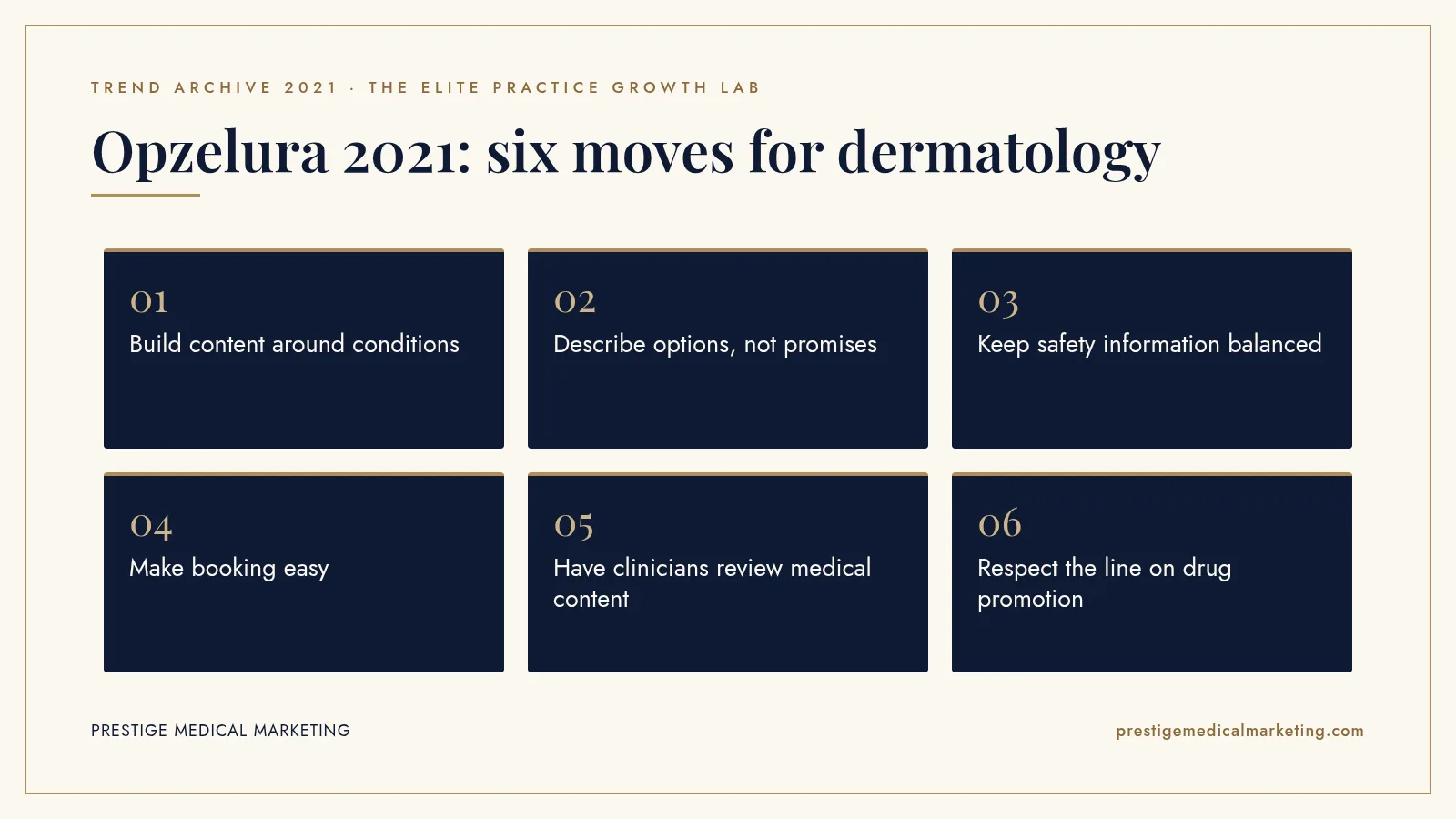
1. Build content around conditions
Comprehensive, clinician-reviewed pages on atopic dermatitis, psoriasis, acne and other conditions serve patients longer than pages about any one product.
2. Describe options, not promises
Explain that treatment depends on individual evaluation and that options range from skin care and topical therapies to newer medications.
3. Keep safety information balanced
When discussing a medication class, acknowledge that it has risks and benefits that the dermatologist will review with each patient.
4. Make booking easy
Patients who read about a new treatment want an answer. A simple online booking path and quick response to calls convert that interest into visits.
5. Have clinicians review medical content
Every page that discusses treatments should be reviewed by a qualified clinician and dated so patients know it is current.
6. Respect the line on drug promotion
Practices should be cautious about content or ads that function as promotion for a specific prescription product. When in doubt, focus on the condition and the practice’s expertise.

Why condition content wins in search
Patients rarely start with a drug name. They search for symptoms and conditions: itchy rash that will not go away, eczema treatment for teenagers, best dermatologist for eczema near me. A practice with thorough, helpful content on those topics meets patients where they actually begin.
That content also earns trust. A page that explains what atopic dermatitis is, what triggers flares, how dermatologists evaluate it and what treatment approaches exist, written clearly and reviewed by a dermatologist, is exactly the kind of resource patients want and search engines reward.
Handling the patient who arrives asking for a specific drug
When a new treatment is in the news, some patients book appointments already convinced it is what they need. Practices can prepare by making sure their website and front desk set expectations: the dermatologist will evaluate the skin, review history and discuss options, which may or may not include a particular medication.
That framing respects the patient’s interest while protecting the clinical relationship. It also avoids the disappointment that comes when a patient expects a specific prescription and learns it is not appropriate for them.
Insurance and access questions
New prescription treatments often come with coverage questions. Patients may ask whether a medication is covered, what it costs and whether prior authorization is required. A practice cannot answer every question in advance, but it can explain on its website that coverage varies, that the team will help with the process and how patients can reach someone with questions.
Clear communication about access is part of the patient experience. A practice that handles it well earns loyalty that outlasts any one prescription.
Medical dermatology and cosmetic dermatology together
Many dermatology practices offer both medical and cosmetic services. Medical conditions like atopic dermatitis bring in patients who may later be interested in cosmetic care, and the reverse is also true. A website that serves both audiences well, with clear navigation and consistent quality, supports the whole practice.
The tone should differ appropriately. Medical content should be calm, accurate and reassuring. Cosmetic content can be more aspirational, but it still needs honesty about results and recovery.
Keeping content current
Dermatology changes quickly. The treatment landscape for atopic dermatitis expanded considerably in the years after 2021, with additional topical and systemic options becoming available. A page written in 2021 and never revisited would soon be out of date.
A simple review schedule, in which a clinician checks key condition pages at least once a year and whenever major changes occur, keeps content accurate. A visible review date tells patients and search engines that the information is maintained.
Answering patient questions between visits
News about a new treatment does not wait for the next appointment. Existing patients send portal messages, call the office and ask during unrelated visits whether the new cream could help them. Practices that plan for that wave handle it better. A short internal note for staff, reviewed by the dermatologists, explains how to respond: acknowledge the question, explain that the dermatologist will review whether it is appropriate and offer a visit if the patient wants to discuss it.
That consistency matters. When different staff members give different answers, patients become confused and may feel the practice is not on top of new developments. When everyone gives the same calm, accurate response, the practice looks organized and current.
Writing about safety without alarming patients
Boxed warnings are serious, and patients deserve to know that medications carry risks. At the same time, a page that lists every possible adverse event without context can frighten people away from care they need. The balance is to explain, in plain language, that every treatment has potential benefits and risks, that the dermatologist reviews those with each patient and that some medications require particular caution or monitoring.
Linking to official prescribing information, rather than paraphrasing it loosely, keeps the practice accurate. Detailed safety discussions belong in the visit, where the dermatologist can consider the individual patient’s history.
Educating families of younger patients
Atopic dermatitis often begins in childhood, and the 2021 approval included patients as young as 12. Parents researching options for a teenager have their own questions about safety, daily routines, school and sleep. Content that speaks to those concerns, written clearly and without hype, helps families feel prepared for the visit and builds trust in the practice as a long-term partner for the patient’s skin health.
Pediatric and adolescent content should be especially careful about claims. Parents are protective, and an accurate, balanced tone is far more persuasive to them than enthusiastic promotion of any new option. Clear, accurate communication about any treatment helps patients arrive at a consultation with realistic expectations and good questions. That clarity builds lasting trust with patients. Always.
What 2021 does not tell us
The 2021 approval did not tell us how widely the cream would be prescribed, how insurers would cover it or how patients would experience it outside clinical trials. There is no reliable public data on how dermatology practices changed their marketing in response. What it does show is that new treatments create waves of patient interest, and that practices with clear, condition-focused content and easy booking are best placed to help those patients well.
The premium practice advantage
A premium dermatology practice is trusted for clinical judgment, clear explanations and an unhurried patient experience. The work is presenting that expertise through accurate content and a smooth path to the visit. See our dermatology services, our dermatology practice marketing guide, our booking engine, our custom websites and our full services. Our team works from Austin with practices nationwide.
The bottom line
The September 2021 approval of Opzelura brought the first topical JAK inhibitor to US patients with mild to moderate atopic dermatitis, with important limits and safety warnings. For dermatology practices, the lasting lesson was to meet patient interest with accurate, condition-focused education and an easy path to an evaluation, rather than promoting any single product.
Check if your market is open. We take one practice per specialty per market. Request a market check or call (716) 400-0084.
Frequently asked questions
What did the FDA approve in September 2021?
The FDA approved Opzelura (ruxolitinib) cream for the short-term and non-continuous chronic treatment of mild to moderate atopic dermatitis in non-immunocompromised patients 12 years of age and older, under specific conditions.
Why was the approval notable?
Incyte described Opzelura as the first and only topical formulation of a JAK inhibitor approved in the United States.
Did the label include safety warnings?
Yes. Incyte's announcement noted boxed warnings for serious infections, mortality, malignancy, major adverse cardiovascular events and thrombosis, seen with JAK inhibitors for inflammatory conditions.
Can a dermatology practice advertise a specific prescription drug?
Practices should be very careful. Promoting specific prescription products raises regulatory and professional considerations, and treatment decisions belong in the clinical visit. Education about conditions and the practice's approach is generally the safer path.
How should a practice talk about new treatments online?
Explain the condition, describe the range of treatment approaches the practice offers, note that options depend on individual evaluation and invite patients to book a visit.
What is the lasting lesson for dermatology marketing?
Build authority around conditions and expertise rather than around individual products, and keep all medical information accurate, balanced and reviewed by clinicians.