
Practices that charge premium prices attract patients who see clear proof of expertise before they ever call: consistent genuine reviews that mention specific results, a professional profile and website, real credentials and photos, and content that answers questions honestly. Discount-led marketing does the opposite and trains patients to shop on price.
If your phone is full of people asking “how much?” and then disappearing, the problem usually isn’t your pricing. It’s your positioning. Patients compare on price when they can’t see a reason to compare on anything else.
Where reputation marketing goes wrong, and how we do it instead
They race to the bottom. We build value.
Deep discounts and daily-deal sites fill the schedule with patients who leave for the next deal. We position your expertise, results and experience so patients compare you on trust.
They chase stars. We build specific proof.
A 4.9 average with vague reviews says less than a steady stream of reviews that name the treatment and the provider. We help you ask every patient, the right way.
They hide criticism. We respond to it.
Calm, professional replies to criticism show future patients how you treat people when something goes wrong.
They polish the ads but not the experience. We align both.
Premium marketing that leads to a rushed phone call and a pushy consult loses the patient. We connect positioning, answering and follow-up into one system, reported monthly in our ROI reporting.

Check if your market is open. We partner with one practice per specialty per market. Request a market check or call (716) 400-0084.
Why price shoppers find you
Look at your Google profile, ads and homepage through a stranger’s eyes. If the first thing they see is a discount, you’ve told them what matters most: price. You’ll attract people who value the deal, not you.
What premium patients look for
- Proof of expertise: credentials, training and experience, stated plainly.
- Social proof: recent, genuine reviews that mention specific treatments and outcomes.
- Real visuals: photos of your actual space and team, and consented results.
- Clarity: honest answers about what to expect, recovery and cost ranges.
- An easy next step: a consult that feels personal, not transactional.
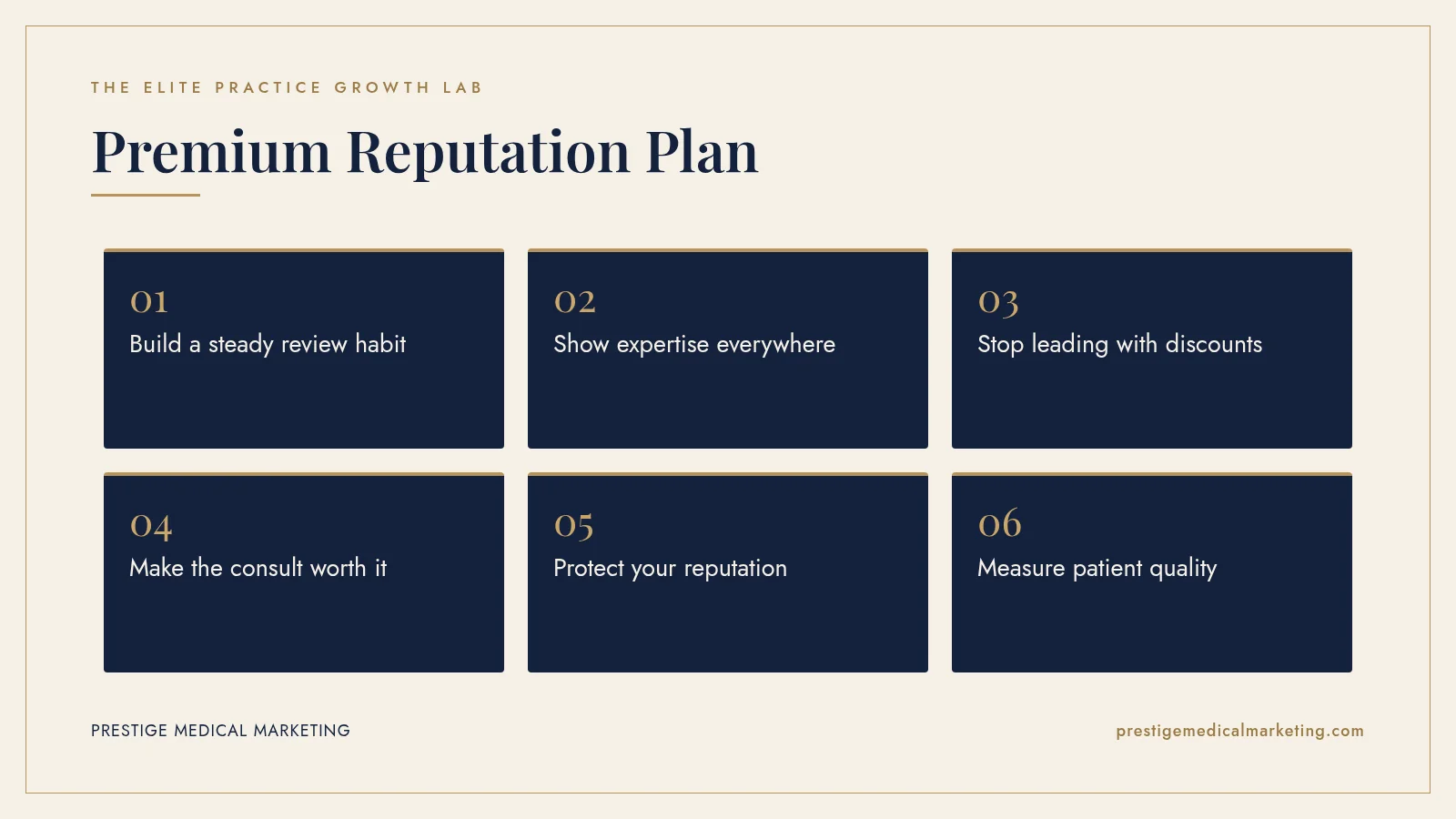
Step 1: Build a steady review habit
Ask every satisfied patient, make it one tap, and ask while the experience is fresh. Never buy reviews or offer incentives for them. Genuine, consistent reviews build trust with patients and with Google. The FTC’s final rule on fake reviews bans fake and incentivized reviews and review suppression, so keep your process clean.
Step 2: Show expertise everywhere patients look
Your website, Google profile and social channels should tell the same story: who you are, what you’re known for, and why patients trust you. Detailed treatment pages and FAQs written in plain English do a lot of the selling before the consult. Our Local Dominance Blueprint shows how that same proof helps you win the Google map pack.
Step 3: Stop leading with discounts
You can still run offers, but make them about value (a consultation, a package, a membership) rather than the lowest price in town. It’s the approach we use for med spas competing in crowded markets.
Step 4: Make the consult worth the price
Premium positioning has to match the experience. A warm, fast response, an easy booking, and a consult that educates rather than pressures all reinforce why you’re worth it. Slow replies undo premium positioning fast; see our guide to lead leakage.
Step 5: Protect your reputation
Monitor reviews, respond professionally, and fix the operational issues that cause complaints. A few thoughtful responses to criticism often build more trust than a wall of five stars.
Step 6: Measure patient quality, not just volume
Track the patients you want, not only the number of leads. Watch average treatment value, consult-to-treatment rate, repeat visits, membership sign-ups and referrals. If those rise while lead volume stays flat, your positioning is working.
What premium positioning looks like in practice
Positioning is a set of specific, visible choices. Compare two practices offering the same treatment:
- Headline: “Botox $9 a unit, this week only” versus “Natural-looking results from a nurse injector with ten years of experience.”
- Photos: generic imagery versus real, polished photos of your space, providers and consented results.
- Pricing: a teaser price that changes at the consult versus an honest range and a clear explanation of what affects cost.
- Booking: “Call for a quote” versus a personal consult with a named provider.
- Follow-up: nothing versus a thoughtful note and a clear plan after the visit.
The second practice does not need to be the cheapest. It gives patients a reason to choose it.
Credentials patients can verify
Expertise has to be visible and checkable. List each provider’s credentials, board certifications, training and years of experience on their bio page. Link to professional profiles where appropriate. State memberships and certifications accurately and keep them current. Patients increasingly verify before they book, and accurate credentials stated plainly carry more weight than adjectives.
Content that earns trust before the consult
Patients who value expertise do their research. Give them content that answers their questions honestly: what a treatment can and cannot do, who is a good candidate, what recovery looks like, the risks and what affects cost. Honest content filters out poor-fit patients and brings in better ones. It also helps search engines and AI assistants recommend you. Our dermatology practice marketing guide shows how to build this kind of content for a medical and cosmetic mix.
How to ask for reviews without feeling awkward
Most happy patients are willing to leave a review. They just need a reminder and an easy link. A few approaches that work well:
- Ask in person at the moment a patient expresses delight with their result.
- Follow up by text the same day with a direct link to your Google review form.
- Make it personal: have the provider or coordinator who treated them send the request.
- Suggest what to mention: “it helps others if you mention the treatment you had.”
- Never gate or filter: ask every patient, not just the ones you expect to be positive.
Turn reviews into marketing (carefully)
With permission, highlight review excerpts on treatment pages and in your Google posts. Keep them accurate and unedited, and avoid anything that reveals health details the patient didn’t share publicly.
Your brand presentation sets the price expectation
Patients judge value within seconds. A dated website, inconsistent logos, blurry photos and typos all suggest a budget experience, whatever you charge. A clean, consistent brand across your website, Google profile, social channels, signage and paperwork tells patients the details matter to you. Invest in professional photography of your space and team, a consistent color palette and type and a clear voice that sounds like your practice. Premium does not mean flashy or expensive-looking for its own sake. It means considered, consistent and confident at every single touchpoint patients see.
The front desk is part of your reputation
Many reviews are about the first and last five minutes of a visit: the phone call, the greeting, the wait and the checkout. Train your team to answer warmly, use the patient’s name, explain what happens next and handle price questions with confidence. Give them a short script for the “how much?” call that shares an honest range, explains what affects cost and offers a consult time. A patient who feels cared for at the front desk is far more likely to accept a premium price and write a review that says so.
Responding to negative reviews
Every practice gets a difficult review eventually. How you respond matters more than the review itself. Reply within a few days, thank the person for the feedback, keep it short and calm and invite them to contact the practice directly. Never confirm that the reviewer is a patient or mention any treatment or health detail; HHS has taken action against providers who disclosed patient information in review responses, so review the HIPAA Privacy Rule with your team. Then fix the issue behind the complaint if there is one.
Memberships and packages, done right
Offers are not the enemy. The right offers reward loyalty instead of training patients to wait for a sale. A membership with a monthly treatment credit, priority booking and member pricing on products builds recurring revenue and relationships. A package for a treatment series improves outcomes and commitment. Keep pricing clear, terms simple and cancellation easy.
Referrals: the most valuable reputation of all
A patient who arrives on a friend’s recommendation already trusts you and rarely shops on price. Make referrals easy: thank patients who refer, give them a simple way to share your booking link and follow up personally. Keep any referral rewards within your state and professional rules, and never tie them to reviews.
Signs your positioning is working
- Fewer calls that start and end with “how much?”
- More consults that turn into treatment plans.
- Higher average treatment value per patient.
- More referrals and repeat visits.
- Reviews that mention providers by name and describe the experience.
The bottom line
Premium pricing is earned online before it’s accepted in the consult room. Build proof, lead with expertise and make the experience match, and you’ll attract patients who value what you do.
See how we position plastic surgeons and longevity clinics. Ready to attract patients who value expertise? Check if your market is open or call (716) 400-0084. We’re based in Austin, Texas, and work with practices nationwide.
Put this playbook to work: see how it applies to the Prestige System for medical practice marketing.
Frequently asked questions
Why do we attract so many price shoppers?
Usually because your marketing leads with price. Discounts and "lowest price" offers attract people who will leave for the next deal. Lead with expertise, results and experience instead.
How many reviews does a practice need?
There is no magic number. Aim for a steady flow of recent, genuine reviews that mention specific treatments, and more than your direct local competitors.
Should we respond to negative reviews?
Yes, calmly and briefly, without confirming that the person is a patient or sharing any health information. Offer to continue the conversation offline.
Can we post before-and-after photos?
Often yes, with the patient's written consent and in line with your state rules and platform policies. Check with your compliance advisor.
Should my practice list prices on its website?
Often, yes. Honest starting prices or ranges, with an explanation of what affects cost, build trust and filter out poor-fit leads. Check any state or platform rules that apply to your specialty.
Do discounts hurt a premium practice?
Deep, frequent discounts train patients to wait for the next deal. Memberships, packages and value-based offers reward loyalty without lowering perceived value.
How do we show expertise without bragging?
State facts plainly: credentials, training, years of experience and the treatments you focus on. Let patient reviews and consented results do the rest.