
Google is piloting a free AI agent that answers messages sent from Business Profiles on Search and Maps. It handles routine questions, helps with bookings and hands complex questions to the business. Google has not published rules for medical practices, so prepare your facts and guardrails before you activate an invite.
AUSTIN, Texas, Oct. 29, 2026. Google has begun inviting businesses into a pilot that lets an AI agent answer messages sent from their Business Profile on Google Search and Maps. For med spas, plastic surgeons, dermatology practices and wellness clinics, that means a patient can soon ask a question from your listing at 10 p.m. and get an answer from Google’s AI before anyone on your team sees it.
Published by the Prestige Medical Marketing team
Google describes the agent as free, says it can help with bookings and says it will pass complex questions to the business. Search Engine Roundtable reported the expansion on Oct. 29. Google has not published which business categories are eligible, and it has said nothing specific about medical or health practices. This guide covers what is confirmed, what patients are likely to ask, the compliance questions a practice should settle first and a checklist to get your listing ready.
Key takeaways for practices
- Google is inviting some businesses to switch on an AI agent behind a Message button on their Business Profile.
- Per Google, the agent answers routine questions, helps with bookings and sends complex questions to you. You can take over at any time.
- It works only for patients whose phone and carrier support RCS messaging. Everyone else texts your phone directly.
- Google has not published eligibility rules, a health-category policy or HIPAA terms for the pilot.
- The agent can only repeat what Google can find. Treatment, pricing, downtime and booking details on your profile and website decide what patients hear.
What Google is rolling out
The invite arrives from Google Business Profile with the subject line “You’re invited: Be the first to get an AI agent for your business.” It offers early access to “the AI-powered messaging pilot on your Business Profile on Search and Maps at no cost.” The core promise, in Google’s words: “You can allow an agent to handle common customer questions and help with bookings, allowing your team to dedicate more time to running the business. Your agent will redirect complex questions to you.”
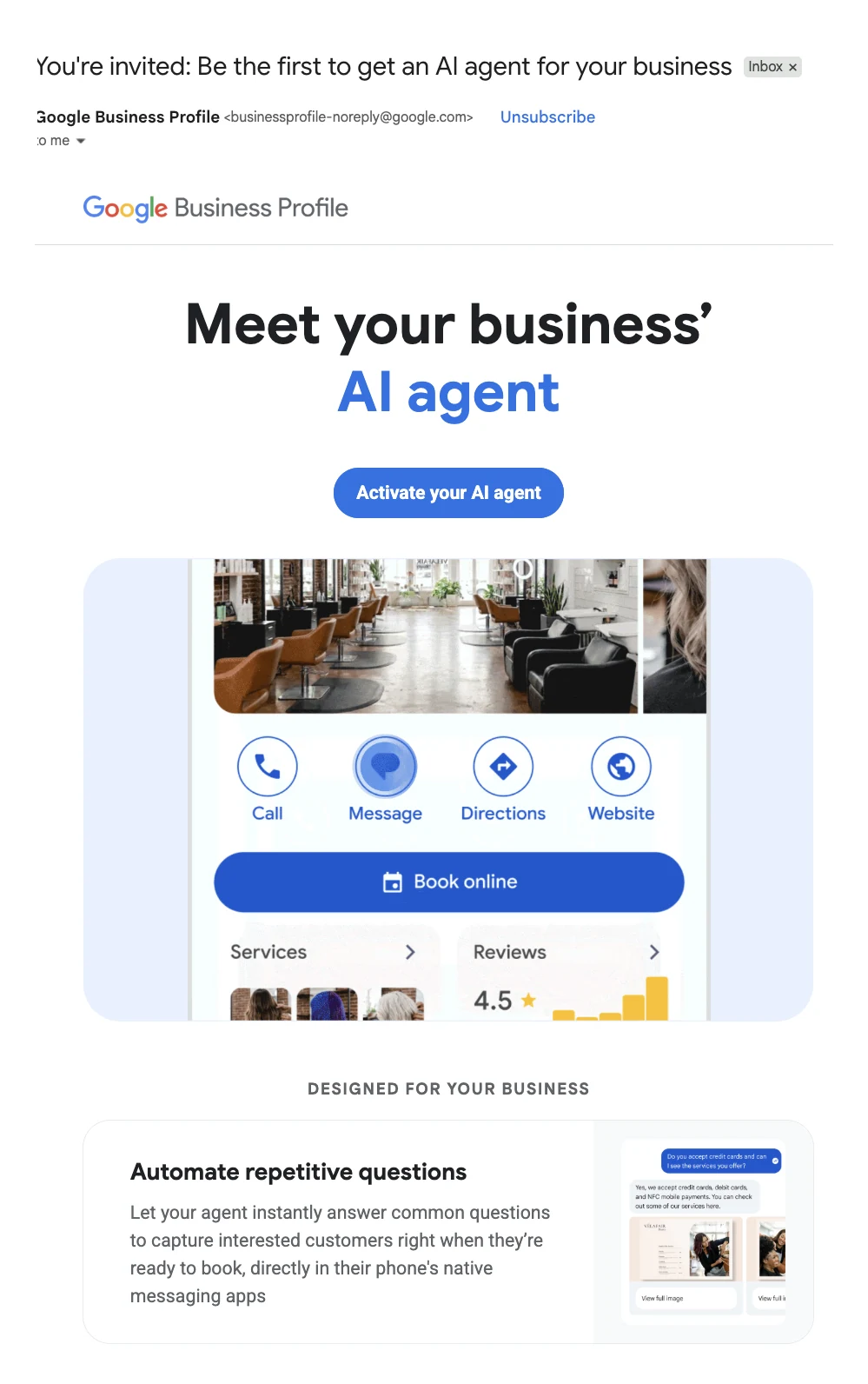
In a statement quoted by Search Engine Roundtable, Google said the feature lets businesses “connect with customers from Search and Maps and let them message your business on their phone’s native messaging app,” and that the AI agent “will answer routine questions from customers, instantly and at no cost.” Search Engine Roundtable also reported that owners can take over a conversation whenever they want and that the messages appear inside the Business Profile.
Patients will not see a chat window. They tap Message on your listing and the conversation opens in their regular texting app, the same place they get appointment reminders from you today.
How it looks to a patient

Google’s demo uses a salon, not a practice, but the pattern carries over. The customer asks a question, the agent answers, offers Saturday times and ends with a booking link. Claudia Tomina, whose LinkedIn notes on the pilot were cited by Search Engine Roundtable, said the agent surfaced menu items with photos and prices and offered reservation times. Her summary is worth taping to the front desk: “The agent can only answer as well as your profile does.”
The RCS limitation
The invite’s fine print, also published by yesweblog.fr, says the agent “is available to customers on participating mobile networks whose phones support RCS. The agent will not reply to other customers, and their messages will go straight to your phone. Standard messaging rates may apply.” Google has not listed which carriers or phones qualify. So expect a split: some patients reach the agent, others text your listed number and wait for a person.
How we got here
Google has run business chat before. It ended Business Profile chat in July 2024, with new conversations stopping July 15 and chat removed July 31, per Google’s Help Center. That version needed staff to reply, and many practices never turned it on.
Since then, Google has been building AI that talks to and about businesses:
- July 16, 2025: Google announced that Search can call local businesses for users to check prices and availability. Businesses can opt out in their profile settings, per Google Help.
- Jan. 11, 2026: Google introduced Business Agent, an AI agent retailers can use to chat with shoppers on Search.
- March 12, 2026: Google launched Ask Maps in the U.S. and India. Google says it draws on information from over 300 million places and reviews from more than 500 million contributors.
- June 26, 2026: A Message button and a “Handled by your AI agent” section appeared on some profiles for a few hours, Search Engine Roundtable reported. Three days later, Darren Shaw of Whitespark wrote that Google appeared to be giving businesses an AI chatbot “that can answer questions about your business from your GBP (and your website?).”
- October 2026: Pilot invites reached owners, covered by yesweblog.fr on Oct. 21 and Search Engine Roundtable on Oct. 29.
What patients will ask it
Ask your front desk for the ten questions they answer most. For an aesthetic or elective practice, almost all of them fall into four groups. These are the questions a Business Profile agent will field first, and the ones where a vague or outdated answer costs you a consult.
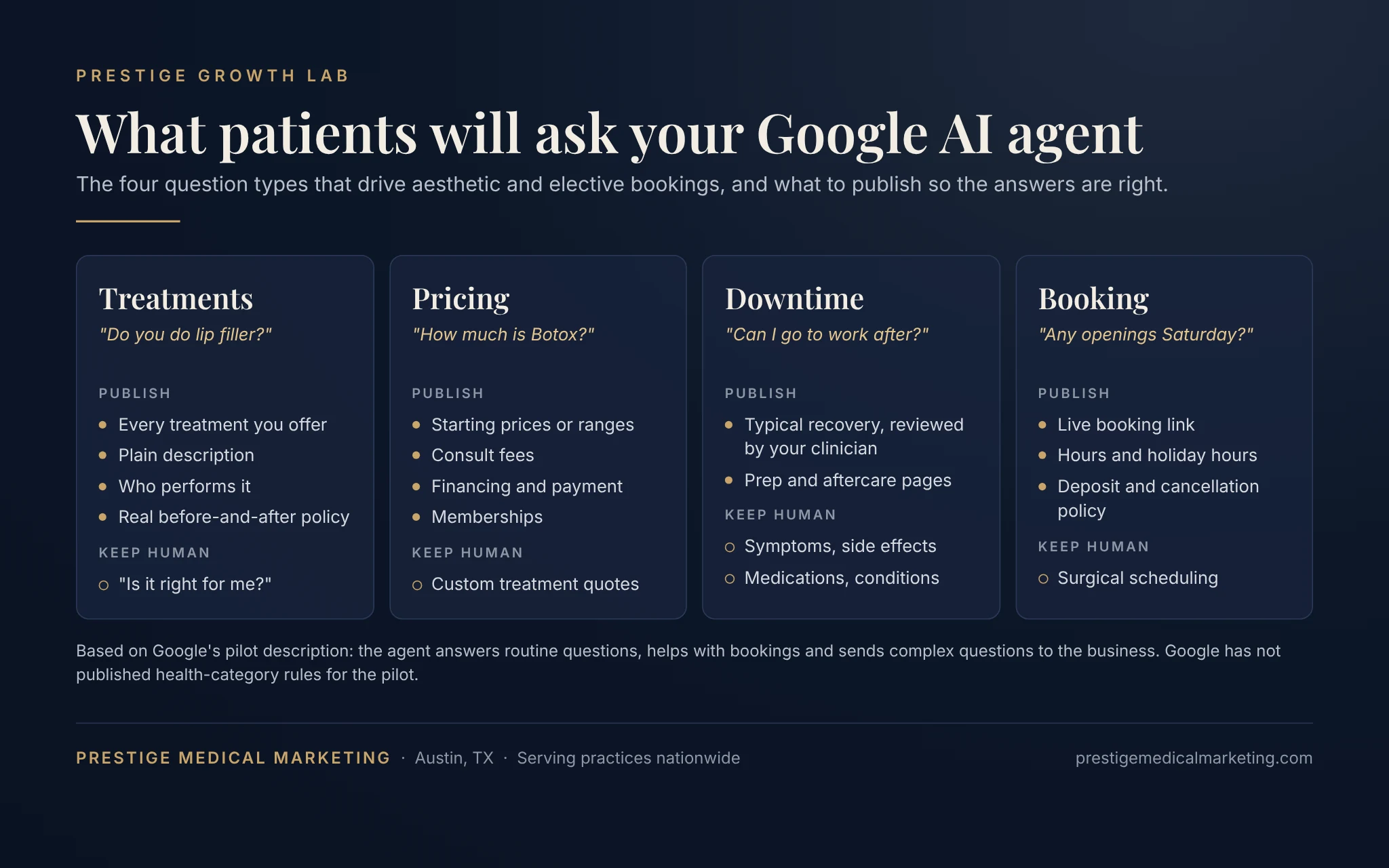
Treatments
“Do you do lip filler?” “Do you offer GLP-1 weight loss programs?” “Do you treat melasma?” The agent can only confirm what your profile and website list. If your Services section says “injectables” and nothing else, it has no way to confirm the specific treatment a patient searched for. List each treatment by the name patients use, with a one-line plain description and who performs it.
Pricing
Price questions are the most common pre-booking message in aesthetics, and the most sensitive. Many practices prefer to quote in person because pricing depends on units, areas or a treatment plan. That is fine. Decide what you are willing to publish, such as “from” prices, ranges, consult fees, financing options or membership pricing, and publish it consistently on your profile and your pricing page. If you publish nothing, the agent may tell patients to contact you, or it may lean on whatever it finds elsewhere. Google has not said which.
Downtime and recovery
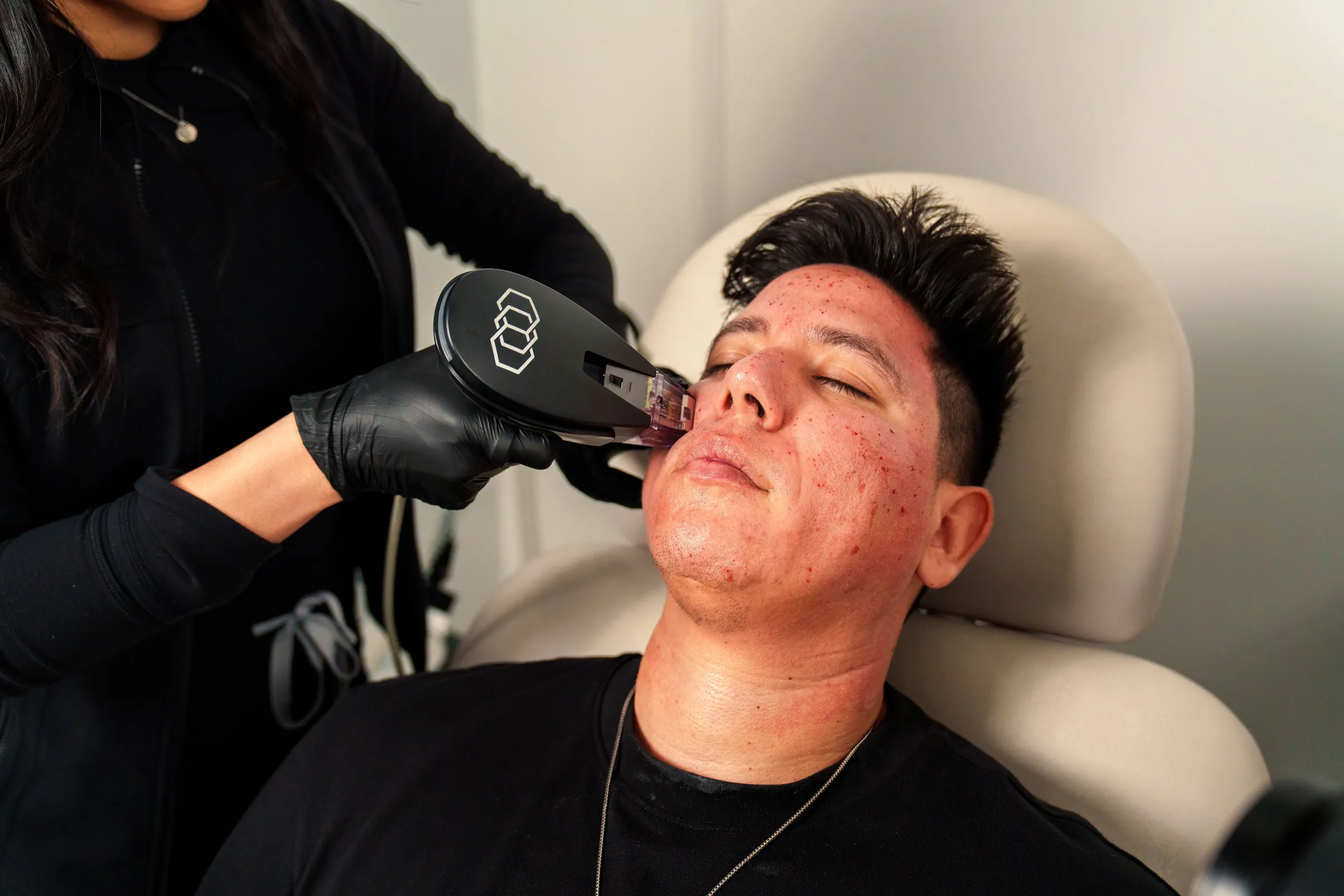
“Can I go back to work the next day?” is a reasonable question and a risky one to automate. Typical recovery information belongs on your treatment pages, written or reviewed by your clinician, with clear language that individual results and recovery vary. Anything that depends on a patient’s health, medications or history needs a person.
Booking
Google’s demo ends with open times and a booking link. That is where the value is for a practice. Make sure the booking link on your profile goes to the right scheduler, works on a phone and shows real availability. Publish your deposit and cancellation policy so the answer is the same whether it comes from the agent or your coordinator.

Compliance: what practices should settle first
This is where we would slow down. Google has not published a help article, eligibility list or policy for the pilot, and nothing we have seen addresses health practices directly. Until it does, treat the agent as a front-desk assistant for public information only, and set your guardrails before you activate an invite.
No medical advice
The agent should answer from public facts about your practice, not give clinical guidance. If a patient asks whether a treatment is safe for them, whether a symptom is normal after a procedure or whether they are a candidate, the right answer is a hand-off to a qualified person. Google says complex questions go to you. Watch the conversations closely in the first weeks to see where the line actually falls.
HIPAA and patient information
Patients will type personal details into a text thread without being asked. HIPAA questions depend on facts we cannot see from the outside, such as how Google stores the messages and what terms apply. HHS guidance on business associates lists, as one example, a third-party chatbot on a provider’s patient portal that handles things like appointment scheduling using patient information. Google has not said how it views its role in this pilot. Before you rely on the agent, talk to your compliance lead or healthcare attorney, do not move clinical conversations into this channel and keep anything involving health details in your secure systems.
No promised results
If your website says “guaranteed results” or “zero downtime,” expect an AI to repeat it. Clean up outcome claims now. Use language like “results vary” and describe what a treatment is designed to do rather than what it will do.
Eligibility is unknown
We do not know yet whether Google will offer the agent to medical categories, restrict some of them or exclude them. If you get an invite, read the terms on the activation screen carefully. If you do not, nothing is lost. The same preparation helps your listing in Maps and AI search today.

Our analysis: where this is likely headed
What follows is our prediction, not something Google has announced. Today the agent answers from the profile details shown in Google’s demo. We expect Google to widen that, so the agent draws on your website, reviews, review replies and third-party listings, and the Message button becomes a kind of “Ask [practice name]” conversation that runs on Google’s terms.
We think this because Google’s AI already reads those sources:
- BrightLocal’s analysis of about 1.9 million local AI citations found Google Business Profile was the most cited source, at about 28.6% of citations, and that roughly 93% of the domains cited were individual business websites.
- Ask Maps already answers questions about places from listings and reviews.
- Joy Hawkins’ team at Sterling Sky reported that AI Local Packs appeared on about 8% of keywords in Places Scout data and surfaced 32% fewer unique businesses. Their advice: “business information needs to be accessible and consistent wherever search engines and AI systems may encounter it.”
For elective practices, the practical risk is inconsistency. A patient sees one price on a directory, another on your site and a third in your reviews, and the agent picks one. The practices that keep one clean version of the facts will be easier for Google to answer for.
What the agent can and cannot do today
Confirmed by Google or early reports:
- Answer routine questions at no cost
- Help with bookings and show open times
- Show services or menu items with photos and prices
- Redirect complex questions to the business
- Let the business take over a conversation
Not confirmed or not possible:
- Replying to patients without RCS. Those messages go to your phone.
- Any published policy for medical or health categories
- HIPAA terms or a business associate agreement for the pilot
- A full list of the sources the agent reads
- Controls to pre-approve or edit its answers
By specialty: what to tighten first
- Med spas: treatment names patients search for (lip filler, Botox, microneedling, laser hair removal), membership and package pricing, and who performs each service. See our notes on marketing for med spas.
- Plastic and cosmetic surgery: consult fees, financing, surgeon credentials and a clear path to a consult. Surgical scheduling and candidacy should always go to your coordinator. Your procedure pages do most of the work here.
- Dermatology: separate cosmetic and medical services, insurance accepted and new-patient wait times. Our dermatology Business Profile guide covers the categories and services fields.
- Weight loss: program structure, consult requirements and pricing, with careful, non-promissory language about outcomes. See weight loss clinic marketing.
- Longevity and men’s health: what a first visit includes, labs or assessments, membership pricing and what requires a clinician. Keep hormone and medication questions human.
Practice checklist
Work through this whether or not you have an invite. Each step also improves how your practice shows up in Maps, AI Overviews and AI Mode.
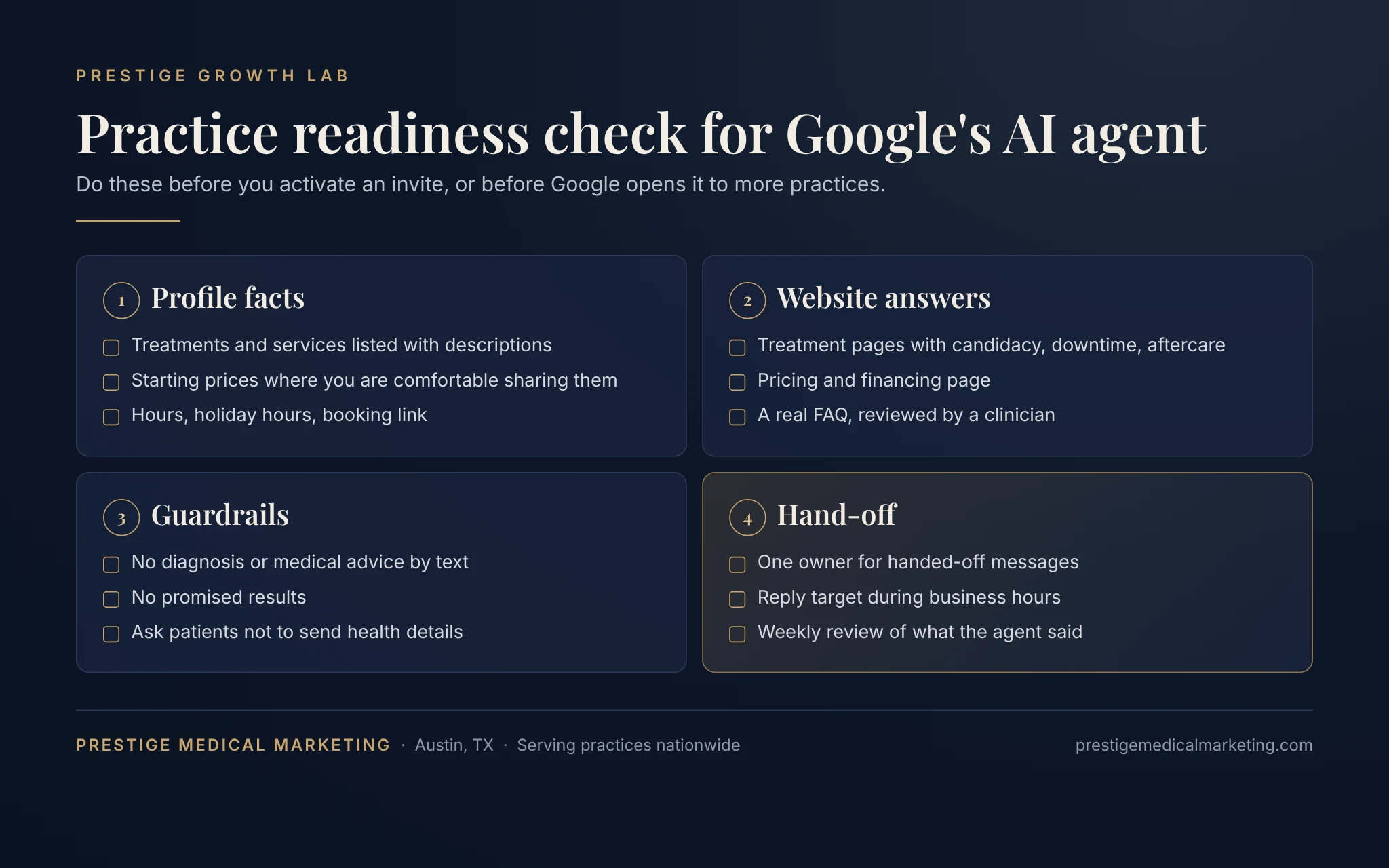
- Check your inbox and the Messages area of your Business Profile for a pilot invite or prompt.
- Confirm the practice owns the Business Profile and remove managers you no longer work with.
- Set primary and secondary categories that match your real services.
- List every treatment by its patient-facing name, with a short description.
- Decide on the pricing you will publish, then make it match on your profile, website and directories.
- Update hours, holiday hours and the booking link, and test the link on a phone.
- Publish treatment pages with candidacy, typical recovery and aftercare, reviewed by a clinician.
- Write an FAQ page with the ten questions your front desk answers most.
- Remove guaranteed-result language from your site, profile and ads.
- Reply to recent reviews and correct outdated details in your replies.
- Check Yelp, Healthgrades, RealSelf, Facebook and Apple Maps for matching name, phone, hours and services.
- Write a short hand-off policy: who answers handed-off messages, how fast and what never goes by text.
- Talk to your compliance lead about patient information in this channel before you activate.
- Once live, message your own listing with five real patient questions and fix whatever comes back wrong.
Should your practice turn it on?
Our honest view: probably, once your facts and guardrails are in place, and if Google offers it to your category. After-hours questions are where many aesthetic consults are lost, and an agent that answers “Do you do this, roughly what does it cost and when can I come in” could recover some of them. The trade-off is control. You are letting Google’s AI speak for your practice, and Google has not yet published how you review or correct what it says.
If you are unsure, prepare anyway. Everything on the checklist above also shapes what AI Overviews, AI Mode and Ask Maps already say about your practice. For the bigger picture, see our guide to medical digital marketing for private practices.
Sources
- Search Engine Roundtable: Google Business Profiles AI-powered messaging (Oct. 29, 2026)
- Search Engine Roundtable: Google Business Profiles Message button test (June 26, 2026)
- Whitespark, Darren Shaw: Google is bringing back GBP Messaging (June 29, 2026)
- yesweblog.fr: AI messaging on Search and Maps for Business Profiles (Oct. 21, 2026)
- Google Business Profile Help: Chat shutdown
- Google: AI calling local businesses from Search (July 16, 2025)
- Google Business Profile Help: Calls from Google
- Google: Business Agent and agentic commerce tools (Jan. 11, 2026)
- Google: Ask Maps and immersive navigation (March 12, 2026)
- BrightLocal: Top sources for local AI search
- Sterling Sky: AI is quietly taking over local SEO (Sept. 21, 2026)
- HHS: HIPAA business associates FAQs
Quotes from the invite email come from a pilot invite we reviewed, with the recipient removed. Sections labeled as our view or prediction are analysis, not statements from Google.
We work with private practices nationwide from our Austin, Texas headquarters at 84 Birrell St. See The Prestige System, the practices we help and how we work.
Want to know what Google’s AI will tell patients about your practice? Book a free 15-minute Practice Growth Call or call (716) 400-0084. We will review your profile, treatment pages and listings and tell you what to fix first.
Put this playbook to work: see how it applies to an AI receptionist for your practice, fast patient follow-up and booking, Google Maps and AI search visibility and med spa marketing.
Frequently asked questions
What is Google's Business Profile AI agent?
It is a pilot that adds a Message button to a Business Profile on Google Search and Maps. An AI agent replies first, answering routine questions and helping with bookings, and passes complex questions to the business. Google says it is available at no cost to invited businesses.
Can medical practices and med spas use the AI agent?
Google has not said. It has not published eligibility rules or a policy for health or medical categories. If your practice receives an invite, read the terms on the activation screen and check with your compliance lead before you turn it on.
Will the AI agent give patients medical advice?
Google describes the agent as handling routine questions and redirecting complex ones to the business. A practice should treat it as a source of public information only, such as services, hours, pricing and booking, and make sure clinical questions go to a qualified person.
Is Google's AI agent HIPAA compliant?
Google has not published HIPAA terms or a business associate agreement for the pilot. Patients may share health details in a text thread, so ask your compliance lead or healthcare attorney before relying on it, and keep clinical conversations in your secure systems.
Will the agent tell patients our prices?
Google's demo and early reports show the agent sharing services or menu items with prices taken from the profile. If you prefer to quote in person, publish what you are comfortable with, such as starting prices, consult fees or financing, and keep it consistent everywhere.
Why are some patients' messages not answered by the agent?
Google's fine print says the agent only replies to customers on participating mobile networks whose phones support RCS. Other patients' messages go straight to the business's phone, so someone on your team still needs to answer them.
How should a practice prepare for Google's AI agent?
Complete your Business Profile, list each treatment by name, decide what pricing to publish, keep hours and booking links current, publish clinician-reviewed treatment and FAQ pages, remove promised-result language and write a hand-off policy for messages that need a person.