
In June 2021, Instagram head Adam Mosseri said Instagram was no longer a photo-sharing app and that it would focus on creators, video, shopping and messaging, including tests of full-screen video and recommended content from accounts people did not follow. Earlier that month, Instagram had explained that Feed, Stories, Explore and Reels each used their own ranking approach. For dermatology practices, the shift meant short educational video and clear expertise would matter more than polished photos alone.
For years, dermatology on Instagram looked like a gallery. Practices posted carefully lit photos of their offices, product shelves, team portraits and before-and-after images. The grid was the brand. Then, in the summer of 2021, the person running Instagram told everyone that the gallery era was ending.
On June 30, 2021, Adam Mosseri said in a video that Instagram was no longer a photo-sharing app. The company would lean into video and entertainment, recommend content from accounts people did not follow and focus on creators, shopping and messaging. For dermatology practices, it was a signal that the way patients discovered skin expertise on social media was about to change.
This retrospective covers what Instagram said in 2021, why it mattered to dermatology, how agencies responded and what still holds. For what came next, see our pieces on Instagram’s 2022 rollback of TikTok-style changes, how Instagram explained ranking in 2023 and Instagram trial reels in 2024.
What actually happened in 2021
June 8: ranking explained. In a post titled Shedding More Light on How Instagram Works, Mosseri explained that there was no single algorithm. Each part of the app, including Feed, Stories, Explore and Reels, used its own ranking process tailored to how people used it. He described the signals Instagram considered, such as how likely someone was to spend a few seconds on a post, comment on it, like it, reshare it or tap the profile photo.
June 30: no longer a photo-sharing app. In a video, Mosseri said Instagram was no longer a photo-sharing app and outlined four priorities: creators, video, shopping and messaging. He said Instagram needed to embrace video more broadly.
Tests and experiments. As The Verge reported, Mosseri described upcoming experiments including recommendations for topics users were not following and a more immersive, full-screen video experience. He openly cited competition from TikTok and YouTube.
Why it mattered for dermatology practices
Skin care is a visual and educational subject. Patients want to understand acne, rosacea, pigmentation, aging skin and skin cancer prevention. They want to know what a treatment involves and who will perform it. Video is well suited to that kind of explanation, and Instagram’s shift meant the app would increasingly reward it.
Recommendations mattered too. When Instagram began showing more content from accounts people did not follow, a clear, useful video from a dermatology practice could reach people who had never heard of it. That created a new path for discovery that did not depend on an existing follower base.
For practices that had invested heavily in a polished grid of still photos, the change was uncomfortable. The grid still mattered for credibility, but it would no longer carry the practice’s social presence on its own.
What typical agencies did
Many agencies responded by copying whatever was trending. They pushed dermatology practices into dances, lip-synced audio and memes that had little connection to skin health. Some of that content performed well on views but did little for the practice’s reputation or bookings.
Others kept producing the same still images and treated video as optional, missing the clear direction Instagram had described.
The agencies that served dermatology well found a middle path. They used short video to explain conditions and treatments, featured the practice’s own dermatologists and clinicians, and kept the tone professional and calm.
What it means for a dermatology practice today
Instagram has changed many times since 2021, but these habits have held up.
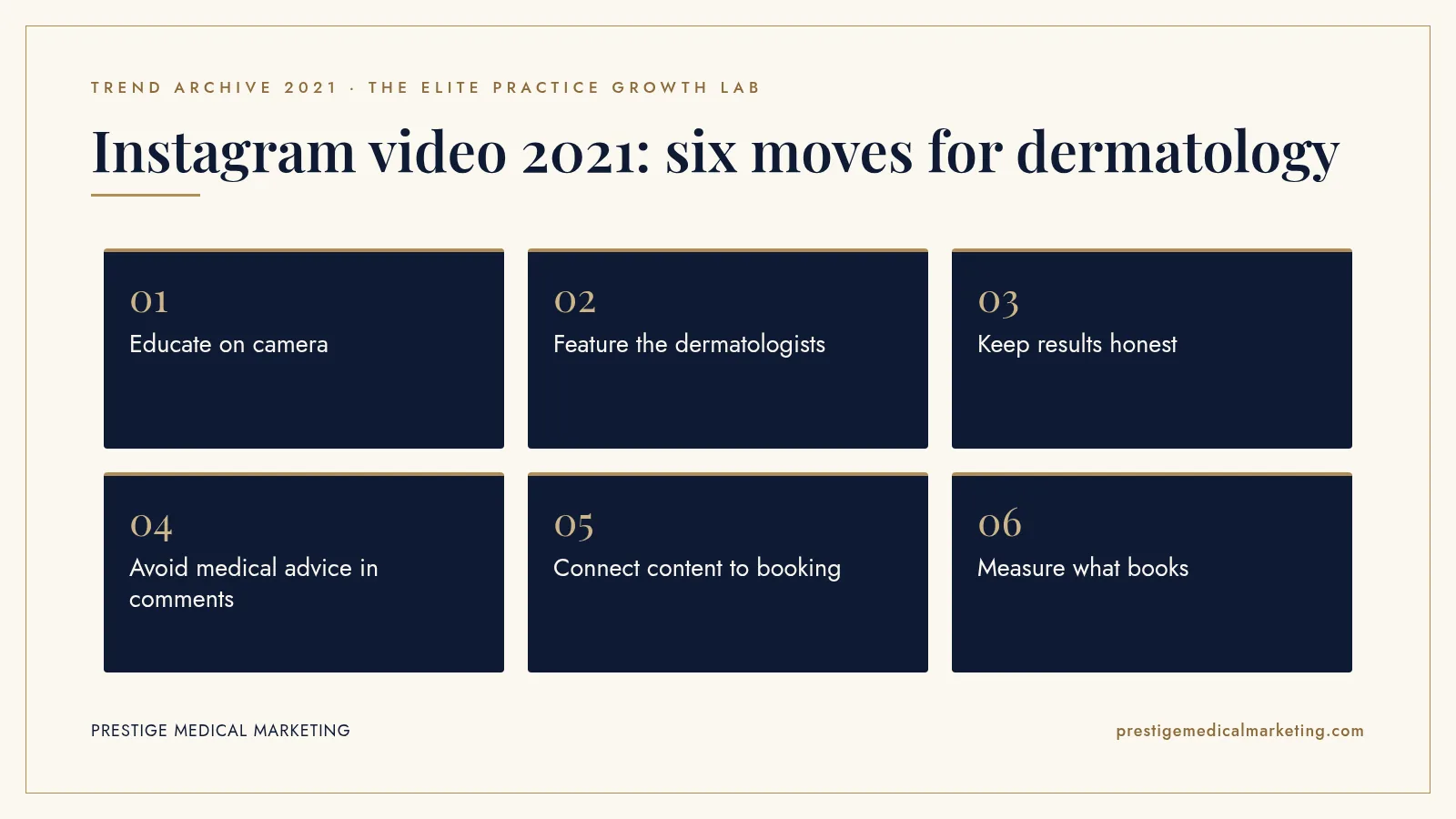
1. Educate on camera
Short videos that answer common skin questions build trust and give recommendations something useful to surface.
2. Feature the dermatologists
Patients choose clinicians. Let your dermatologists and providers explain their approach in their own words.
3. Keep results honest
Before-and-after content should be consented, consistent and accompanied by context that results vary.
4. Avoid medical advice in comments
Answer general questions publicly and invite specific concerns to a visit or a secure channel.
5. Connect content to booking
Make it easy to move from a video to the website and a booking page, especially on a phone.
6. Measure what books
Track inquiries and visits by source in the practice’s own systems rather than judging content by views alone.

Medical credibility in a short format
Dermatology content on social media competes with influencers, product promoters and misinformation. A board-certified dermatologist explaining why a popular skin trend may irritate the skin, or how to tell when a mole should be checked, offers something those voices cannot: medical credibility. Short video does not have to dilute that. A clear, accurate thirty-second explanation can be more valuable than a long caption.
The key is accuracy. Every clinical statement should be correct, appropriately cautious and consistent with what the dermatologist would say in a visit. Content should be reviewed before it is posted.
Balancing medical and cosmetic content
Many dermatology practices serve both medical and cosmetic patients. Social content can reflect both, but the balance should match the practice’s goals. A feed that is entirely cosmetic may attract aesthetic clients but undersell the practice’s medical depth. A feed that is entirely clinical may miss patients interested in cosmetic care.
A thoughtful mix, such as skin cancer awareness, acne education and cosmetic treatment explanations, presents the practice as a complete skin care partner.
Production that fits a busy practice
Dermatologists are busy, and video production can feel like a burden. It does not have to be elaborate. A good phone, decent lighting in a quiet room and a short list of questions patients ask most often are enough to start. Batching several short videos in one session, once or twice a month, keeps the workload manageable.
The practice can then use those videos on Instagram, on the website and in patient emails, getting more value from each recording. A little planning turns one afternoon into a month of useful posts.
Privacy and consent on camera
Any patient who appears in content should give clear written consent covering how the content will be used. Skin conditions can be sensitive, and a patient who agreed to a clinical photo for their chart has not agreed to appear on social media. Staff should also be careful about what appears in the background of videos filmed in the office, such as screens or charts.
Shopping and product content
Instagram’s 2021 focus on shopping created an opening for practices that sell skin care products. Product content can be useful when it explains why a dermatologist recommends a type of product and how to use it. It becomes less useful, and less credible, when it turns into constant promotion. Practices should keep product content in proportion to education and disclose any relationships with brands.
Messaging as a front door
Mosseri named messaging as one of Instagram’s four priorities, describing it as the main way people connect with close friends on the app. For practices, direct messages became another way prospective patients reached out. Someone should own that inbox, respond promptly and move scheduling and health details to secure channels.
Building a library rather than a feed
Social content tends to disappear from view within days. A smarter approach treats each useful video as part of a lasting library. The same explanation of how to manage rosacea flares can live on the relevant condition page of the website, in a new patient email and on a YouTube channel. Over a year, the practice builds a set of trustworthy resources that keep working long after the original post has scrolled away.
Reels, Stories and Feed serve different jobs
Mosseri’s June 2021 explanation of ranking was useful precisely because it showed that each part of Instagram behaves differently. Stories were largely about people a user already followed and felt close to. Feed blended familiar accounts with a growing share of suggestions. Explore and Reels were built for discovery, surfacing content from accounts the viewer might never have seen before.
For a dermatology practice, that meant matching content to the job. Stories suit existing patients: reminders about seasonal skin care, office updates and quick answers. Reels suit discovery: clear, self-contained explanations that make sense to someone who has never visited the practice. Feed posts can anchor the brand with consented results, team introductions and longer educational carousels. A practice that posted the same thing everywhere missed the strengths of each format.
Writing captions and on-screen text that help
Many people watch short videos with the sound off. On-screen text and captions make sure the main point lands either way. A dermatology video about sunscreen should state the key message in plain words on the screen, not rely entirely on narration. Captions also make content more accessible to viewers who are deaf or hard of hearing, which is simply good practice for a medical provider.
The caption below the post is a chance to add context, such as who is speaking, a reminder that individual advice requires a visit and a clear path to book. Keep it brief and accurate rather than stuffing it with hashtags.
Consistency beats virality
A single video that reaches a large audience can be exciting, but it rarely changes a practice on its own. What builds a dependable presence is consistency: a steady rhythm of helpful, accurate posts over months, from the same recognizable clinicians, with the same calm tone. Patients who see a practice explain skin concerns clearly again and again come to trust it before they ever book.
That kind of consistency also makes the workload predictable. A simple monthly plan, built around the questions patients ask most often and the services the practice wants to grow, keeps content focused and prevents the scramble that leads to off-brand posts.
What 2021 does not tell us
Instagram did not publish data on how the shift affected different kinds of accounts, and many of the 2021 experiments changed or were rolled back in 2022 after user feedback. There is no reliable public data on how dermatology practices’ social performance changed as a group. What 2021 does show is that Instagram was moving toward video and recommendations, and that practices able to educate clearly on camera were well placed for that shift.
The premium practice advantage
A premium dermatology practice has what good social content needs: real expertise, clear explanations and a patient experience worth showing. The work is presenting it consistently and measuring what leads to visits. See our dermatology services, our dermatology practice marketing guide, our booking engine, our full services and who we help. Our team works from Austin with practices nationwide.
The bottom line
When Instagram said in June 2021 that it was no longer a photo-sharing app, it signaled a lasting shift toward video, recommendations and messaging. For dermatology practices, the lesson was to educate on camera, feature their own clinicians, keep content accurate and connect it to an easy path to a visit.
Check if your market is open. We take one practice per specialty per market. Request a market check or call (716) 400-0084.
Frequently asked questions
What did Instagram announce in June 2021?
Adam Mosseri said Instagram was no longer a photo-sharing app and that the company would focus on four areas: creators, video, shopping and messaging.
What changes did Instagram say it would test?
Mosseri described tests including recommended content from accounts users did not follow and a more immersive, full-screen video experience.
How does Instagram rank content?
In June 2021 Instagram explained that each part of the app, including Feed, Stories, Explore and Reels, uses its own ranking process tailored to how people use that part of the app.
Why did the shift matter to dermatology practices?
Many practices relied on still photos of results and offices. The move toward video and recommendations rewarded practices that could explain skin concerns and treatments clearly on camera.
Did Instagram keep every 2021 change?
No. In 2022, after user pushback, Instagram rolled back some full-screen and recommendation tests, though video and recommendations remained central.
What should a dermatology practice post today?
Short, accurate educational videos featuring the practice's dermatologists and clinicians, consented results with context and clear information about how to book.