
Beginning January 1, 2022, the No Surprises Act required health care providers and facilities to give uninsured and self-pay individuals a good faith estimate of expected charges when they schedule a service at least 3 business days in advance or ask for an estimate. CMS guidance names physical therapy as an example where a single estimate can cover recurring services. Patients can dispute a bill that is at least $400 more than the estimate. For cash-pay physical therapy practices, clear pricing became part of compliant booking.
Cash-pay physical therapy practices have long competed on time, attention and outcomes. Without insurance limits on visits or documentation, they can offer longer sessions, one-on-one care and treatment plans built around the patient’s goals rather than a payer’s rules. Price is part of that proposition, and the best practices have always been open about it.
In 2022, federal law made openness about price a formal requirement for many patients. Beginning January 1, the No Surprises Act required health care providers to give uninsured and self-pay individuals a good faith estimate of expected charges. Much of the coverage focused on surprise bills from hospitals and out-of-network doctors, but the estimate rules reached a wide range of outpatient providers, including physical therapists treating self-pay patients.
This retrospective covers what the rules required and what they mean for a cash-pay physical therapy practice today. For related chapters, see the end of the public health emergency in 2023 and the 2025 Medicare pay cut and cash-pay physical therapy.
What actually happened in 2022
January 1: estimates required. According to CMS guidance, beginning January 1, 2022, the No Surprises Act required all health care providers and facilities to provide an estimate of expected charges to uninsured individuals and to self-pay individuals who have coverage but do not intend to use it.
When it applies. The estimate must be provided when such a person schedules an item or service at least 3 business days in advance or requests an estimate.
Deadlines. CMS guidance sets timing: no later than 1 business day after scheduling when the service is 3 to 9 business days away, and no later than 3 business days after scheduling when it is at least 10 business days away. A requested estimate is due within 3 business days.
Recurring care. CMS says a provider expecting to furnish recurring items and services may provide a single estimate for them, naming counseling services and physical therapy as examples.
Disputes. The estimate must explain the right to dispute a bill if charges are at least $400 more than expected. CMS consumer guidance explains how patients can start that process.
Federal program exclusion. CMS guidance says individuals enrolled in federal health care programs such as Medicare are not eligible for good faith estimates, because other protections apply.
Why it mattered for cash-pay physical therapy
Physical therapy is usually a course of care, not a single visit. A patient recovering from a knee injury or managing back pain may need many sessions over weeks or months. For a self-pay patient, the total cost matters as much as the price per visit, and uncertainty about that total can delay a decision.
The good faith estimate rules required practices to address that uncertainty in writing. An estimate lists the expected items and services, codes and charges. For a cash-pay practice, preparing one forces clarity about the plan of care and its cost.
The rules also touched marketing. A practice that advertises a price but delivers an estimate with a very different total creates confusion and potential disputes. Consistency between the website, the phone conversation and the written estimate became essential.
What typical agencies did
Most marketing agencies did not notice the rules at all, since the headlines about surprise billing seemed to concern hospitals and emergency rooms rather than outpatient practices. They kept running campaigns built around free screenings or vague pricing, leaving the front desk to reconcile marketing promises with the estimate requirements.
Some practices responded by removing prices from their websites entirely, worried that published prices might conflict with estimates. That often made the practice look less transparent at the moment transparency had become a legal expectation.
The better approach aligned marketing, booking and estimates: clear published pricing, a booking process that captured coverage status, and estimate templates that matched both.
What it means for a physical therapy practice today
CMS guidance has been revised since 2022. These steps reflect the core requirements. Confirm current details with CMS and counsel.
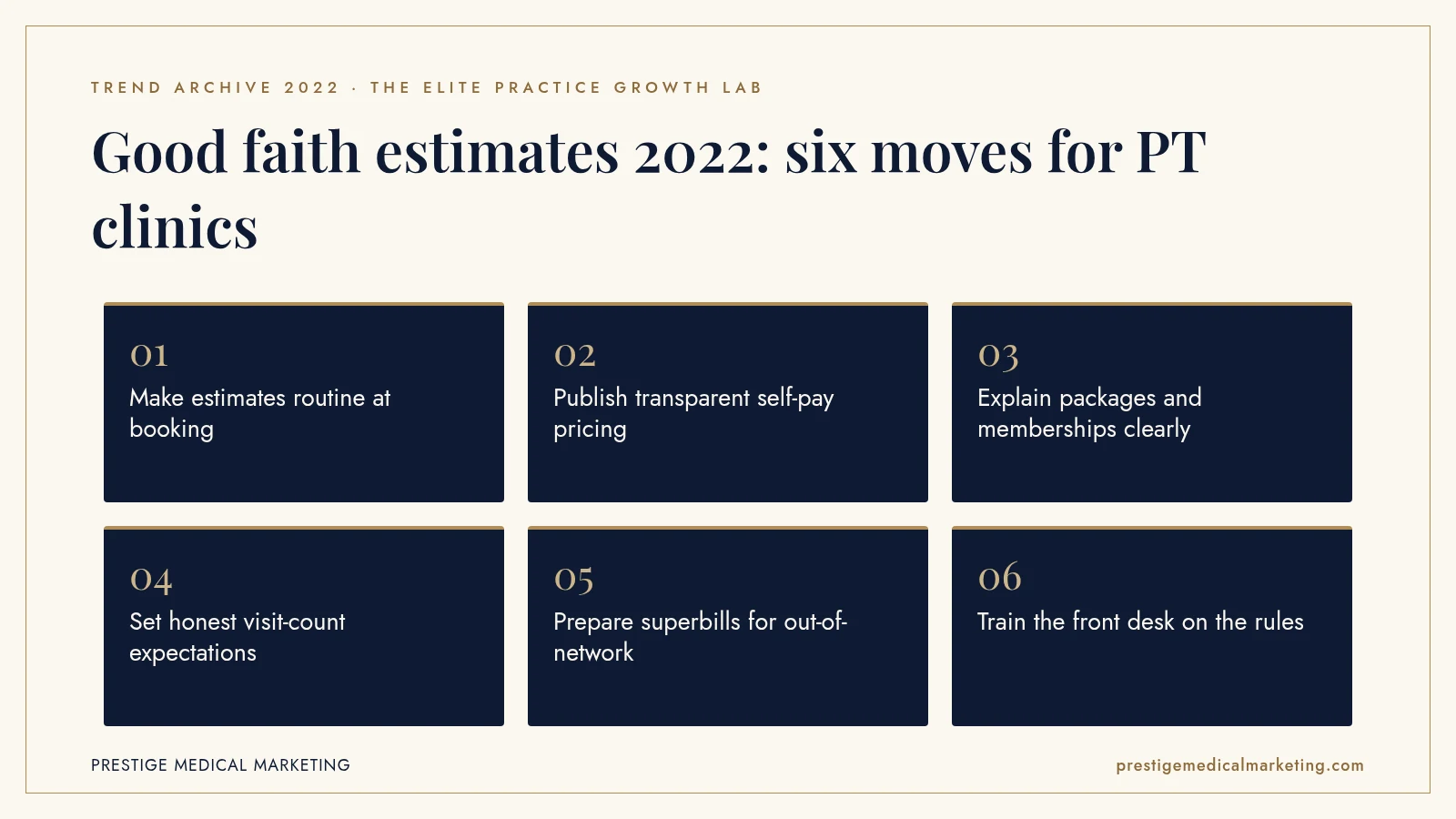
1. Ask about coverage at booking
Determine whether each new patient is uninsured, self-pay or using insurance, and whether a federal program applies.
2. Build estimate templates
Prepare templates for common plans of care that include the required information and realistic visit counts.
3. Meet the deadlines
Set up workflows so estimates go out within 1 or 3 business days, as required by scheduling timing.
4. Use recurring estimates
Where appropriate, provide a single estimate covering a course of recurring physical therapy services.
5. Align your website
Make sure published prices, packages and promotions match what estimates will show.
6. Update when plans change
If the expected services change before a visit, issue a new estimate as CMS guidance requires.

Transparent pricing as a growth asset
For a cash-pay practice, the estimate rules were less a burden than a nudge toward something that already works. Patients choosing to pay out of pocket want to know what they are buying. A practice that explains its pricing clearly on the website, in the first phone call and in a written estimate removes a major source of hesitation.
Clear pricing also attracts the right patients. People who understand the cost before booking are more likely to commit to the full plan of care, which supports better outcomes and fewer cancellations. People who would be uncomfortable with the price can decide early, saving time on both sides.
Many cash-pay practices present pricing as a per-visit rate with typical plan lengths for common conditions, or as packages. Either can work, as long as it is honest about what is included and consistent with the estimates the practice issues.
Packages, memberships and promotions
Many cash-pay physical therapy practices sell packages of visits, monthly memberships for ongoing care or wellness programs, and introductory offers for new patients. Each of these can be a sensible way to make care more accessible. Each also needs to fit cleanly with the estimate a self-pay patient receives.
A package price should appear on the estimate in a way the patient can recognize, with the number of visits and what each includes. A membership should be explained in terms of what it covers and how it ends, so the patient understands the total commitment. An introductory offer should be clear about what happens after the first visit, since a low first-visit price followed by a much higher plan of care is exactly the kind of surprise the law aimed to reduce.
Marketing claims deserve the same care. Phrases like all-inclusive or no hidden fees are only helpful if they are literally true. When a practice’s advertising, website and written estimates tell the same story, patients notice the consistency and trust the practice more for it.
Making estimates routine
Estimates work best when they are built into systems rather than prepared by hand each time. Practice management and scheduling software can often flag self-pay appointments and generate estimates from templates. A short checklist for front desk staff, covering coverage status, scheduling date, the estimate deadline and delivery method, keeps the process consistent across busy days.
Patients should receive estimates in the format they prefer, and CMS guidance says written estimates must follow any verbal estimate given over the phone or in person. Keeping copies in the patient’s record makes it easier to answer questions later and to show that requirements were met.
Reviewing a sample of estimates each quarter, comparing them with final bills, helps a practice catch templates that consistently underestimate visit counts or omit items. That review improves both compliance and the patient experience over time.
The booking conversation
The estimate rules changed the first conversation with a new patient. Front desk staff need to ask whether the patient has coverage and whether they plan to use it, then explain that an estimate will follow. Done well, this conversation reinforces professionalism. Done poorly, it sounds like paperwork and fine print, and a patient who was ready to book may decide to think it over instead.
Training helps. A short script that explains the practice’s pricing, confirms the patient’s coverage status and sets expectations about the estimate keeps the conversation clear. Staff should also know how to answer common questions, such as whether a patient can use a health savings account or request a superbill for out-of-network reimbursement, without making promises about insurance outcomes.
Plans of care and honest visit counts
An estimate for a course of physical therapy depends on how many visits the therapist expects. Estimating too few visits makes the total look attractive but sets up a larger final bill. Estimating too many can discourage patients unnecessarily. The goal is a realistic, clinically grounded expectation based on the evaluation.
Where the plan of care is uncertain at the first visit, a practice can explain that clearly and update the estimate after the evaluation, following CMS guidance on changes. Patients generally respond better to honest uncertainty than to a low number that turns out to be wrong.
Superbills and out-of-network patients
Some patients with insurance choose a cash-pay physical therapy practice and seek reimbursement from their plan afterward. Whether a good faith estimate is required depends on whether the patient intends to submit a claim, and practices should follow CMS guidance on how to treat these situations. Clear intake questions help staff decide which process applies.
Marketing should be careful here. Promising that a plan will reimburse a certain amount is risky, since coverage varies. It is more accurate to explain that the practice provides documentation patients can submit and that reimbursement depends on their plan.
A short page on the practice website explaining how superbills work, what documentation the practice provides and what patients should ask their plan can save staff many repeated phone calls. It also signals that the practice understands the financial side of choosing cash-pay care.
What 2022 does not tell us
The good faith estimate rules set requirements; they did not tell us how many practices complied, how patients used estimates or how often disputes occurred. Guidance has been revised since 2022, and some details are complex. We cannot say how the rules affected demand for cash-pay physical therapy. What 2022 established is that clear, written cost estimates became an expected part of care for uninsured and self-pay patients.
The premium practice advantage
A premium cash-pay physical therapy practice wins patients with clarity about care and cost. See our physical therapy services, our physical therapy marketing guide, our booking engine, our full services, who we help and how we approach Google Maps and AI search visibility. Our team works from Austin with practices nationwide.
The bottom line
From January 2022, the No Surprises Act required good faith estimates for uninsured and self-pay patients. For cash-pay physical therapy, aligning website pricing, booking and estimates turned a compliance task into a trust advantage.
Check if your market is open. We take one practice per specialty per market. Request a market check or call (716) 400-0084.
Frequently asked questions
What is a good faith estimate?
Under the No Surprises Act, an estimate of expected charges that providers and facilities must give uninsured or self-pay individuals within set timeframes, starting January 1, 2022.
When must a good faith estimate be provided?
When an uninsured or self-pay individual schedules an item or service at least 3 business days in advance, or asks for an estimate. CMS sets deadlines of 1 to 3 business days depending on timing.
Who is a self-pay individual?
Someone with certain types of health coverage who does not intend to use it for the service. CMS guidance says people enrolled in federal health care programs such as Medicare are not eligible for these estimates.
Does physical therapy need an estimate for every visit?
CMS guidance says a provider expecting to furnish recurring services may give a single good faith estimate covering them, and names physical therapy as an example.
What happens if the bill is much higher than the estimate?
CMS says patients may be able to dispute a bill that is at least $400 more than the estimate for a provider, through the patient-provider dispute resolution process.
Is this legal advice?
No. Requirements are detailed and have been clarified over time. Confirm your obligations with CMS guidance and a qualified healthcare attorney.