
Med spa SEO means ranking for the treatments people search with a credit card in hand, like "Botox near me" or "lip filler [city]." It takes one strong page per treatment, a fully built Google Business Profile, steady real reviews, fast mobile pages and tracking that ties every ranking to booked appointments.
Most med spa owners have paid for SEO at least once. The report came every month, full of green arrows and “keyword wins,” and the books looked the same. That is not an SEO problem. It is a scoreboard problem. The goal is booked treatments from people who live close enough to come back every three months. Everything below is built around that number.
What med spa SEO actually has to win
Search for “lip filler near me” on your phone. You see a short list of ads, a map with three practices and then a handful of websites. Med spa SEO is the work of owning the map spot and the first organic results for the treatments that carry your margin. For most practices that is neurotoxin, filler, skin tightening, laser and medical-grade facials, in roughly that order.
Two surfaces decide almost every new client:
- The map pack. Google ranks local results on relevance, distance and prominence, and says so in its own local ranking guidance. You control relevance and prominence. Distance you control with a smart location.
- Treatment pages. When someone searches “Morpheus8 [city]” or “how much is Botox,” Google wants the page that answers that exact question. A homepage cannot rank for twenty treatments.
A third surface is growing fast: AI assistants. BrightLocal’s 2026 Local Consumer Review Survey found the share of consumers using ChatGPT and other AI tools for local recommendations jumped from 6% to 45% in one year. The same fundamentals feed all three.
Where most med spa SEO goes wrong, and how we do it instead
Owners on r/MedSpa describe the same pattern again and again: a retainer, a report about “optimized meta tags,” and flat bookings. Here is what that looks like up close.
They report rankings. We report booked treatments.
Ranking first for your own business name is not a win. Neither is ranking for “what is a med spa.” We tie organic traffic and map actions to calls, bookings and revenue by treatment, and our ROI reporting shows that every month.
They build one services page. We build a page for every treatment.
Each treatment gets its own page with who it is for, what to expect, downtime, how many sessions, starting price, provider credentials and real questions answered. That is what ranks, and it is what converts.
They buy links. We earn local authority.
Cheap link packages are the fastest way to a traffic cliff. We build authority from things that hold up: local press, real partnerships, association listings and content people actually cite.
They sign you to twelve months. We work month to month.
If the work is good, you stay because it is good. Long lock-ins protect the agency, not the practice.
They work for the med spa down the street. We don’t.
We take one practice per specialty per market. Your SEO partner should not be ranking your direct competitor for the same terms.

Check if your market is open. We partner with one med spa per market. Request a market check or call (716) 400-0084.
The med spa SEO plan, step by step
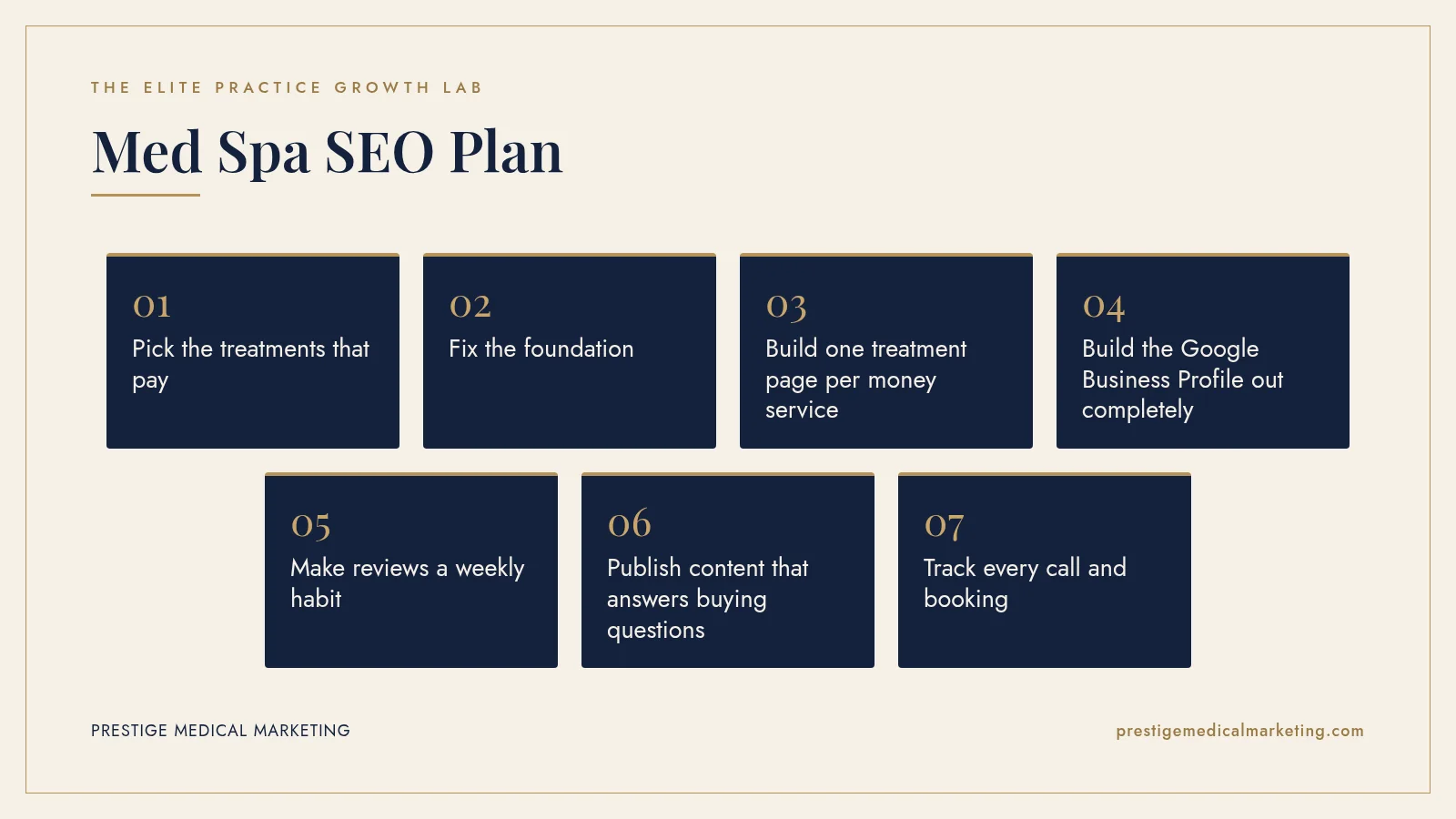
Step 1: Pick the treatments that pay
List every treatment with its average ticket, margin, rebooking rate and provider capacity. Rank them. Neurotoxin usually leads because clients return every three to four months. Your SEO plan starts with the top five, not the full menu.
Step 2: Fix the foundation
Your site must load fast on a phone, show a clear “Book” button on every screen, and work without pop-ups that cover the content. Check that Google can crawl every treatment page, that each page has one clear H1, and that your name, address and phone match everywhere they appear.
Step 3: Build one treatment page per money service
Each page answers the questions a client asks before booking: Is it right for me? Does it hurt? How long does it last? What does it cost? Who does it? Add real before-and-after photos with consent, provider bios with credentials, and FAQ answers written in plain language.
Step 4: Build the Google Business Profile out completely
Primary category, secondary categories, every service with a description, booking link, real photos of your space and team, and regular updates. Our Google Business Profile guide for med spas walks through every field.
Step 5: Make reviews a weekly habit
Ask every happy client, every week, with a direct link by text. Reply to every review in your own words. Never buy reviews and never filter out unhappy clients before they can post. The FTC’s 2024 rule on fake reviews allows civil penalties for fake and incentivized reviews.
Step 6: Publish content that answers buying questions
Skip “10 skincare tips for fall.” Write the pages a client reads the week before booking: “Botox vs. Dysport,” “How long does lip filler last,” “Morpheus8 downtime.” Link each one to the matching treatment page.
Step 7: Track every call and booking
Call tracking, form tracking and booking tracking connected to analytics, so you know which page and which search produced each appointment. If you cannot see it, you cannot grow it.
Treatment pages that rank and convert
A strong treatment page is short on fluff and long on answers. Here is the structure we use:
- A direct answer up top. What the treatment does and who it is for, in two or three sentences.
- Results and timeline. When clients see change, how long it lasts and when to rebook.
- Price guidance. A starting price or a range. Hiding cost sends people to the competitor who shows it.
- Your provider. Name, credentials, years injecting, and a real photo.
- Proof. Consented before-and-after photos and reviews that mention that specific treatment.
- Questions answered. Pain, downtime, aftercare, safety and candidacy.
- One clear action. Book online or call. Not five competing buttons.
Keep claims honest. The FTC’s health products guidance expects health claims to be backed by competent and reliable scientific evidence. “Smoother lines for three to four months” is a fair claim. “Look ten years younger” is not.
Local signals that move the map
- Consistent listings. Same name, address and phone on Google, Apple Maps, Yelp, Facebook and the directories clients use.
- Fresh reviews. BrightLocal found 74% of consumers only care about reviews from the last three months. A burst of reviews two years ago does little today.
- Review replies. 89% of consumers expect owners to respond, and templated replies put off half of them, per the same survey.
- Real photos. Your reception, your treatment rooms, your team. Not generic images that appear on fifty other sites.
- Local relevance. Neighborhood mentions, local partnerships and community events give Google and AI assistants reasons to connect you to your area.
The mistakes we fix first
When we audit a med spa site, the same problems show up in the first hour. Fixing them often moves results before any new content goes live.
- Booking friction. The “Book” button opens a third-party page that loads slowly, asks for an account and shows no treatment names. Clients leave. Shorten the path to two taps.
- Duplicate treatment pages. Three thin pages for “Botox,” “Botox Injections” and “Wrinkle Relaxers” compete with each other. Merge them into one strong page and redirect the rest.
- Images that slow the page. Oversized photos push mobile load times past what visitors will tolerate. Compress, resize and serve modern formats.
- No provider names. Clients book an injector, not a building. Pages without named, credentialed providers lose trust and lose the click.
- Mismatched details. An old suite number on Yelp, a former phone number on Facebook. Inconsistent listings weaken local signals and confuse clients.
- Missed calls from search. Organic traffic that rings to voicemail at 6 p.m. is wasted. Our missed calls breakdown shows what that leak costs.
How to measure med spa SEO without fooling yourself
Ask for these numbers every month:
- Calls, direction requests and website clicks from the Google Business Profile
- Organic sessions to treatment pages, not general articles
- Bookings and calls attributed to organic search
- New clients by treatment and the revenue they produced
- Rebooking rate for clients who came from search
If a report leads with keyword positions and never mentions bookings, it is telling you what the agency did, not what you got. Our med spa marketing guide covers the paid and social side of the same system.
Choosing a med spa SEO partner
Before you sign anything, ask five questions. Who owns the website, the domain and the analytics? How will you connect rankings to booked treatments? What happens to everything if I leave? Do you work with other med spas in my market? What will month one look like compared with month six? Clear answers are a good sign. Vague ones tell you what the next twelve months will feel like.
We built our med spa program around those answers, with custom websites, unlimited edits, speed-to-lead follow-up and a 24/7 AI receptionist so organic leads never hit voicemail. See the full stack on our services page.
Ready to rank for the treatments that pay? Check if your market is open or call (716) 400-0084. We’re based in Austin, Texas, and work with practices nationwide.
Put this playbook to work: see how it applies to plastic surgery marketing and dermatology practice marketing.
Frequently asked questions
How long does med spa SEO take to work?
Expect early movement on your Google Business Profile and long-tail treatment terms in the first 60 to 90 days. Competitive terms like "Botox [city]" usually take four to nine months of steady work. Anyone promising page one in two weeks is buying shortcuts that tend to backfire.
Is SEO or Google Ads better for a med spa?
They do different jobs. Ads buy bookings this month and stop when you stop paying. SEO builds an asset that keeps producing. Most med spas should run both, then shift budget toward organic as treatment pages and the map listing start carrying their weight.
How many pages does a med spa website need for SEO?
One dedicated page for every treatment you want to sell, plus a page for each major concern you treat, such as fine lines or sun damage. A single "Services" page listing twelve treatments ranks for none of them.
Do reviews really affect med spa rankings?
Yes. Google lists prominence, which includes review count and rating, as a local ranking factor. Reviews also decide the click. BrightLocal's 2026 survey found 47% of consumers won't use a business with fewer than 20 reviews.
Should a med spa publish prices online?
Publish starting prices or ranges where you can. Searchers and AI assistants both favor pages that answer the cost question, and a clear range filters out bargain hunters before they reach your front desk.
What should a med spa SEO report show?
Calls, form fills and online bookings from organic search and the map listing, booked appointments, and revenue by treatment. Keyword positions belong at the bottom of the report, not the top.