
Hims & Hers completed its business combination with Oaktree Acquisition Corp. on January 20, 2021, and began trading on the NYSE as HIMS the next day, receiving about $279.5 million in proceeds before transaction expenses. The company described itself as a multi-specialty telehealth platform connecting consumers to licensed healthcare professionals. For local men's health clinics, the lesson was to compete on what a national app could not easily offer: in-person evaluation, continuity with a known clinician and a personal experience.
Few industries felt the rise of consumer telehealth as sharply as men’s health. Brands built around discreet online visits and home delivery had already been advertising heavily for years. In January 2021, one of the best known of them became a publicly traded company, with fresh capital and a stated ambition to become the front door to the healthcare system.
On January 20, 2021, Hims & Hers completed its business combination with Oaktree Acquisition Corp., a special purpose acquisition company, and began trading on the NYSE under the ticker HIMS the following day. For local men’s health clinics, it was a clear sign that consumer telehealth was not a passing pandemic trend. It was a permanent, well-funded competitor for attention.
This retrospective covers what happened, why it mattered and what local clinics can take from it today. For related chapters, see our pieces on the 2024 DEA telemedicine extension and the oral testosterone approvals of 2022.
What actually happened in 2021
January 20: the deal closed. According to the company’s announcement, Hims & Hers completed its business combination with Oaktree Acquisition Corp. and would begin trading on the NYSE under the ticker HIMS on January 21, 2021.
The capital. The company said it received proceeds of approximately $279.5 million, before transaction expenses.
The positioning. Hims & Hers described itself as a multi-specialty telehealth platform that connects consumers to licensed healthcare professionals for conditions related to mental health, sexual health, dermatology, primary care and more.
The ambition. CEO and co-founder Andrew Dudum said the company had made tremendous progress in 2020 toward its mission of becoming the front door to the healthcare system, and that it intended to transform categories including primary care and mental health.
Why it mattered for men’s health clinics
National telehealth brands compete differently from local clinics. They spend heavily on advertising across television, podcasts, social media and search. They design every step of the experience for a phone. They emphasize convenience, privacy and speed. A man researching treatment for a sensitive concern could find one of these brands within seconds.
The public listing reinforced that this competition was well funded and here to stay. Local clinics could no longer assume that patients would search only for nearby providers. Many would compare a local clinic with an app before deciding.
At the same time, the model had limits that local clinics could address. Some patients wanted an in-person examination, lab work interpreted by a clinician they could meet and an ongoing relationship with a known provider. The clinics that understood this could position themselves as a different kind of choice rather than a more expensive version of the same thing.
What typical agencies did
Some agencies tried to outspend the national brands on the same channels and keywords, often with poor results. A local clinic could not match the budget or reach of a public company.
Others copied the tone of consumer telehealth ads, leaning on discreet packaging and quick online forms, while the clinic itself still delivered an in-person model. The mismatch confused patients.
The better approach was positioning. It meant explaining the value of in-person care honestly, making the booking experience as smooth as an app and investing in local search and reputation, where a nearby clinic held a natural advantage.
What it means for a men’s health clinic today
Consumer telehealth remains a major force in men’s health. These habits help local clinics compete.
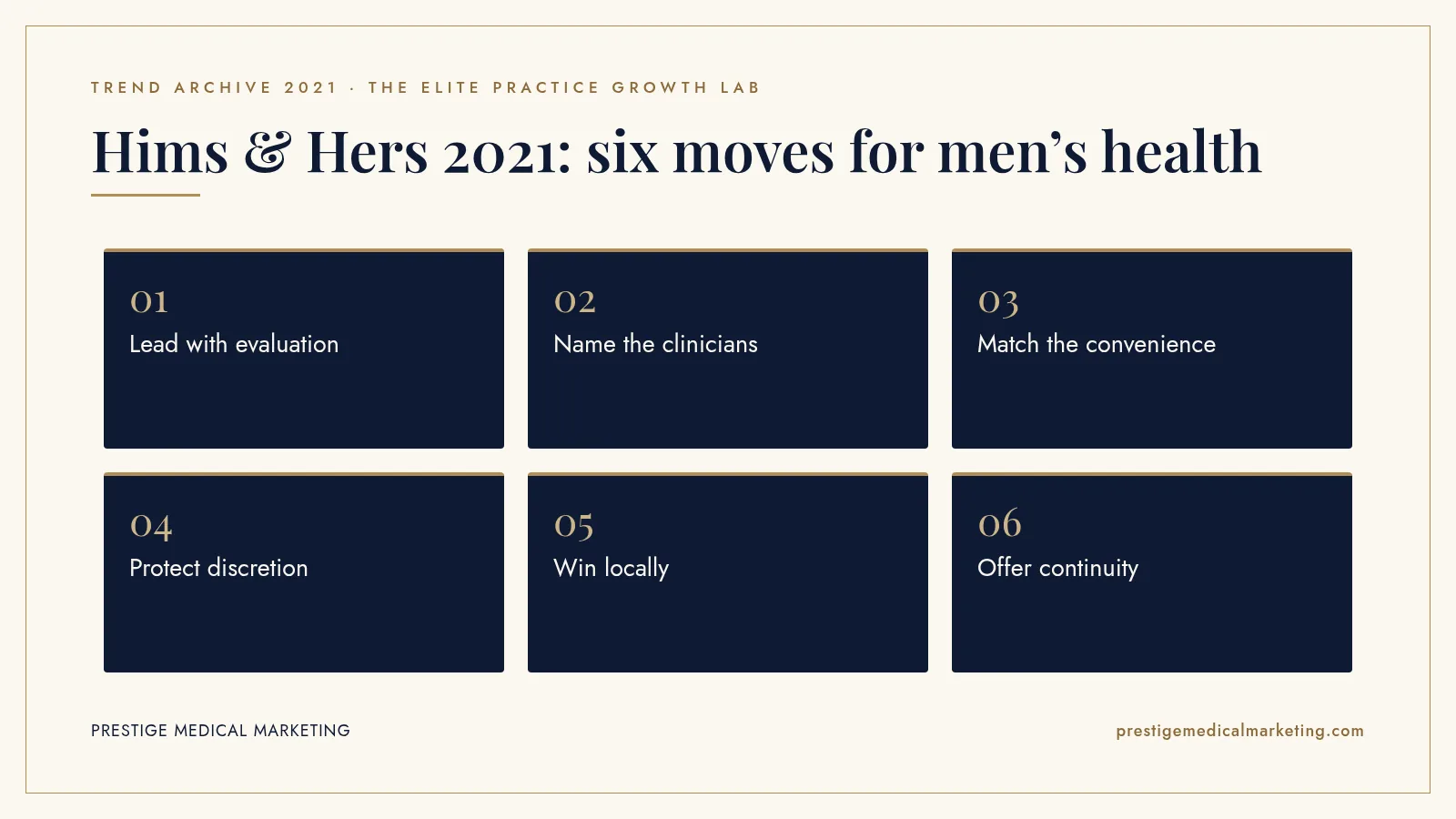
1. Lead with evaluation
Explain how in-person assessment and appropriate testing inform treatment decisions, without disparaging other models.
2. Name the clinicians
Patients choosing between an app and a clinic want to know who they will see. Clear clinician profiles build that confidence.
3. Match the convenience
Online booking, quick responses and clear pricing information remove the friction that pushes patients toward apps.
4. Protect discretion
Men’s health concerns are personal. Private intake, discreet communication and a comfortable environment matter.
5. Win locally
Strong Google Business Profile listings and genuine reviews give a local clinic visibility that national brands do not have in the same way.
6. Offer continuity
Ongoing follow-up with the same clinician is a meaningful advantage. Make it visible.

Competing on experience rather than budget
A national brand can outspend a local clinic many times over, but it cannot easily replicate a calm, private consultation with a clinician who remembers the patient’s history. That is where local clinics can stand out. The website, the first phone call, the waiting area and the follow-up should all communicate attention and discretion.
When the experience is genuinely better for patients who value it, the clinic does not need to win every comparison. It needs to win the patients for whom in-person care is the right choice. Those patients are often the most loyal, the most likely to return for follow-up and the most likely to recommend the clinic to friends.
Being honest about price
Consumer telehealth brands often display prices prominently. Patients comparing options notice when a clinic’s pricing is unclear. Local clinics do not need to match app pricing, but they should explain what a visit includes, what testing may be involved and how follow-up works. Clear information about value reduces hesitation and filters for patients who appreciate a more comprehensive model. It also prevents surprises at checkout, which are a common source of disappointed reviews.
Reputation as a local moat
Reviews tell prospective patients what it is actually like to visit a clinic. A steady stream of genuine reviews describing respectful, discreet care is difficult for a national brand to replicate at the local level. Clinics should make it easy for satisfied patients to share their experience, respond professionally to all reviews and never offer incentives for reviews.
Search visibility in a crowded field
National telehealth brands are highly visible in paid search for men’s health terms. A local clinic usually does better focusing on local intent, such as searches that include the city or near me, and on its Google Business Profile. Organic content that answers patient questions clearly also builds visibility over time. Paid search can play a role when it is targeted carefully, measured honestly and connected to a fast booking path.
Respecting the patient’s choice
Some patients genuinely prefer telehealth, and that is a legitimate choice. Clinics that offer their own virtual follow-up options, where appropriate and permitted, can serve patients across preferences. The goal is not to argue that one model is always better, but to make the clinic’s model clear and appealing to patients who value it.
Ethical prescribing as a brand value
Men’s health treatments often involve prescriptions, and patients increasingly hear concerns about care delivered too quickly. Clinics that emphasize appropriate evaluation, careful prescribing and follow-up monitoring offer reassurance. That message should be stated honestly, without implying that other models are unsafe, and supported by how the clinic actually practices.
Watching the market without chasing it
After 2021, national telehealth brands kept expanding into new categories and services. Local clinics cannot predict every move, but they can watch how patients respond. When patients start asking about a new kind of service they saw advertised, that is a signal to review whether the clinic offers something comparable, how it explains it and whether its booking path makes it easy to try. Responding thoughtfully, rather than copying every trend, keeps the clinic focused on what it does best.
Making the first contact feel private
Part of the appeal of consumer telehealth is that a man can begin without speaking to anyone. Local clinics can reduce that barrier too. Online booking, a short and respectful intake form, the option to message before calling and front desk staff trained to handle sensitive topics calmly all make the first step easier. Small details, such as neutral appointment reminders and discreet billing descriptions, signal that the clinic understands why privacy matters to its patients.
The advertising environment patients live in
By 2021, a man interested in treatment for hair loss, sexual health or low energy encountered consumer telehealth ads almost everywhere: podcasts, streaming services, social feeds, subway platforms and search results. Those ads shaped expectations. They suggested that treatment could begin in minutes, from a phone, with little friction. Whether or not a patient ever used one of those services, he arrived at a local clinic carrying those expectations.
Clinics that recognized this adjusted their messaging. Rather than ignoring the ads, they addressed the questions those ads raised: how long does it take to be seen, what does an evaluation involve, why might testing matter and what happens after the first visit. Answering those questions plainly on the website, in the clinic’s own voice, helped patients understand the difference without the clinic needing to mention any competitor by name.
Designing the website like a product
One lesson local clinics could borrow from consumer telehealth was design discipline. The best telehealth brands made every page clear, fast and focused on one next step. Many clinic websites, by contrast, were cluttered, slow on phones and vague about how to begin. A local clinic does not need an app, but it benefits from the same clarity: a fast mobile site, a short explanation of each service, honest information about what to expect and a booking button that is always within reach.
Good design also signals quality. A patient deciding between a polished national brand and a local clinic often judges both by their digital experience first. A refined, calm website tells him that the clinic takes care seriously before he ever walks through the door. Trust compounds over time.
What 2021 does not tell us
The 2021 listing did not tell us how consumer telehealth companies would perform over time, how regulation of remote prescribing would evolve or how patients would divide between apps and local clinics. There is no reliable public data on how local men’s health clinics were affected by the listing itself. What 2021 does show is that well-funded consumer telehealth brands became a permanent part of the landscape, and that local clinics compete best by being clearly different rather than imitating them.
The premium practice advantage
A premium men’s health clinic offers careful evaluation, discretion and continuity with a known clinician. The work is presenting those strengths clearly and making the path to a visit as easy as an app. See our men’s health services, our men’s health clinic marketing guide, our booking engine, our reputation and premium pricing work and our full services. Our team works from Austin with practices nationwide.
The bottom line
When Hims & Hers began trading on the NYSE in January 2021, it confirmed that consumer telehealth brands would remain powerful, well-funded competitors in men’s health. For local clinics, the lasting lesson was to compete on evaluation, continuity, discretion and local reputation, while matching the convenience patients had come to expect.
Check if your market is open. We take one practice per specialty per market. Request a market check or call (716) 400-0084.
Put this playbook to work: see how it applies to med spa marketing.
Frequently asked questions
When did Hims & Hers go public?
The company completed its business combination with Oaktree Acquisition Corp. on January 20, 2021, and began trading on the NYSE under the ticker HIMS on January 21, 2021.
How much did the company receive from the transaction?
Hims & Hers said it received proceeds of approximately $279.5 million, before transaction expenses.
How did Hims & Hers describe itself?
As a multi-specialty telehealth platform that connects consumers to licensed healthcare professionals for conditions related to mental health, sexual health, dermatology, primary care and more.
Why did the listing matter to local men's health clinics?
It signaled that well-funded consumer telehealth brands would keep competing for the same patients, with large marketing budgets and polished digital experiences.
Can a local clinic compete with a national telehealth brand?
Yes, by emphasizing in-person evaluation, appropriate testing, continuity with a named clinician, local reputation and a fast, polished booking experience.
Should a clinic criticize telehealth competitors in its marketing?
No. It is better to explain the clinic's own approach clearly and honestly and let patients choose the model that fits them.