
On June 24, 2021, Google said Chrome would phase out third-party cookies over a three-month period that would start in mid-2023 and end in late 2023, later than the early 2022 target it had set before. The delay gave advertisers more time, but it did not change the direction of travel toward less cross-site tracking. For men's health clinics, the practical lesson was to build measurement on first-party data and keep third-party tracking off sensitive pages rather than wait for a deadline.
Men’s health clinics live on discretion. A man researching testosterone therapy, erectile dysfunction treatment or hair restoration is often doing it late at night on his phone, and he would prefer that nobody else knows. That is exactly why the long story of the third-party cookie matters to this specialty.
Third-party cookies are the small files that let an advertising company recognize the same browser across many different websites. For two decades they powered retargeting, audience building and much of digital ad measurement. In 2020, Google committed to phasing them out of Chrome. In June 2021, it announced that the phase-out would take longer than planned.
This retrospective covers what Google actually said in 2021, what it meant for clinics that advertised online and why the right reading of the delay was not relief but preparation. For how the story ended, see our piece on Chrome keeping third-party cookies in 2025 and what it means for HIPAA tracking, and for the related federal scrutiny, our look at the 2022 Meta Pixel investigation into hospital websites.
What actually happened in 2021
January: the Privacy Sandbox moves forward. Early in 2021, Google described its progress on the Privacy Sandbox, a set of proposals meant to support advertising without cross-site tracking. Its January 2021 update discussed FLoC, an approach that grouped browsers with similar browsing interests into cohorts, and explained the intention to make third-party cookies obsolete in Chrome.
June 24: the timeline changes. Google published an updated timeline for Privacy Sandbox milestones. It said Chrome would phase out third-party cookies over a three-month period, starting in mid-2023 and ending in late 2023, subject to its commitments to the UK Competition and Markets Authority. Google said more than 30 proposals had been offered by Chrome and others, and four were already available in origin trials.
The reason given. Google said it needed more time across the ecosystem to get this right, so that publishers, advertisers and developers could test the new technologies and migrate their services without jeopardizing the business models of many web publishers.
The industry response. Advertisers and ad technology companies largely welcomed the extra time. Privacy advocates were less impressed. For clinics, the most important point was easy to miss: nothing in the announcement suggested that cross-site tracking would become more acceptable, only that one browser would take longer to restrict it.
Why it mattered for men’s health clinics
Men’s health marketing has leaned on retargeting for years. A visitor reads about low testosterone symptoms, leaves and later sees an ad reminding him to book a consultation. That pattern depends on recognizing the same browser across sites, which is precisely what third-party cookies made possible.
The trouble is that the pages involved are sensitive. A page about erectile dysfunction treatment or a form asking about symptoms reveals far more than a page about a restaurant menu. Any third-party script that records visits to those pages is collecting information patients would consider private, and in many cases it is sending that information to companies the clinic does not control.
By 2021, Safari and Firefox were already blocking third-party cookies by default. Apple’s App Tracking Transparency arrived the same spring. Chrome’s delay meant one major browser would continue allowing them for a while, but the larger trend was obvious. A men’s health clinic whose growth depended on cross-site tracking was building on ground that was steadily shifting.
What typical agencies did
Many agencies treated the June announcement as permission to change nothing. Retargeting campaigns kept running, tracking pixels stayed on every page and reports kept crediting conversions to whichever platform claimed them. The planning horizon became the new deadline rather than the underlying trend.
Some agencies did the opposite and promised that new Privacy Sandbox tools would simply replace cookies. That was speculative. In 2021 the proposals were still being tested, FLoC itself was later abandoned and the eventual outcome was very different from what most people predicted.
The more useful response was quieter. It meant auditing which scripts ran on which pages, removing tracking that was not needed and building a reporting system that counted real patients in the clinic’s own records.
What it means for a men’s health clinic today
The specific deadline turned out not to matter. The habits that prepared a clinic for it still do.
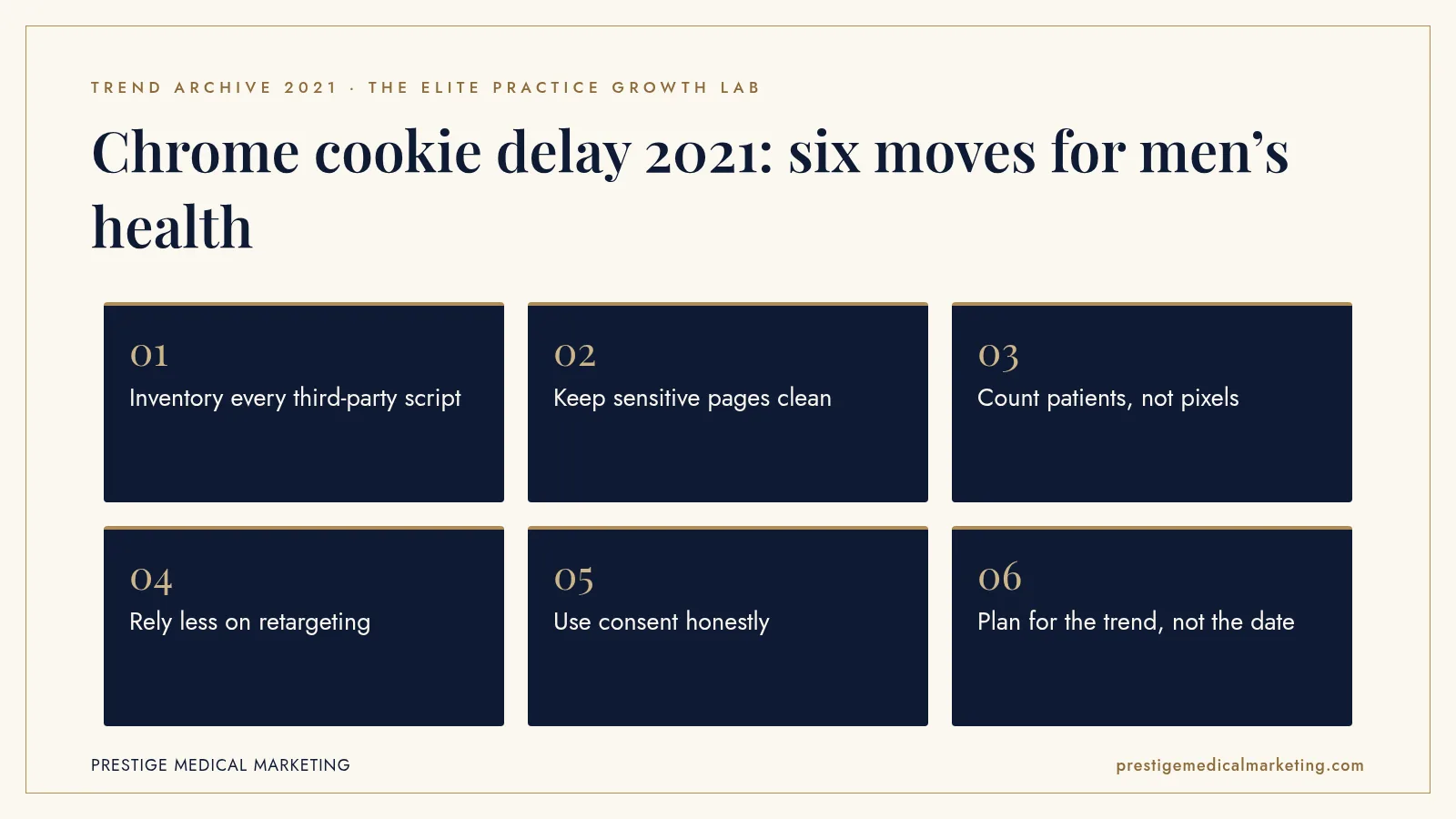
1. Inventory every third-party script
List each tag, pixel and embedded tool on the site, which pages it runs on and what it collects. Many clinics find scripts left over from old campaigns or vendors they no longer use.
2. Keep sensitive pages clean
Condition pages, symptom questionnaires, intake forms and booking flows should carry only the scripts that are strictly necessary, reviewed for privacy and HIPAA risk.
3. Count patients, not pixels
Record each inquiry’s source in the clinic’s own system and follow it through to the consultation and the first treatment visit. That ledger works regardless of browser policy.
4. Rely less on retargeting
Retargeting audiences shrink as browsers restrict tracking. A clear, persuasive first visit does more than chasing someone around the internet afterward.
5. Use consent honestly
Where tracking is used, explain it in plain language and respect a visitor’s choice. Discretion is a selling point for this specialty, and the privacy policy should reflect it.
6. Plan for the trend, not the date
Browser timelines change. The direction toward less cross-site tracking has been consistent for years and is the safer basis for planning.

The privacy expectations of a men’s health patient
A man who books a testosterone consultation is trusting the clinic with something personal. He expects that his visit to a page about erectile dysfunction will not follow him around the internet in the form of ads, and he certainly does not expect it to be shared with a social network. When that expectation is broken, the damage is to trust, which is the clinic’s most valuable asset.
That is why the cookie question is not only technical. A clinic that runs aggressive retargeting on sensitive topics may produce a short-term lift in reported conversions while quietly making prospective patients uncomfortable. A clinic that keeps its site clean and its messaging discreet is aligned with how its patients want to be treated.
What first-party measurement looks like
First-party measurement simply means the clinic records what happens in its own systems. Every inquiry, whether it arrives by form, phone call, text or chat, is logged with a date and a source. The front desk notes whether a consultation was booked and attended and whether the patient started treatment. Once a month, the clinic compares those counts with spend and effort by channel.
This approach does not need cookies at all. It needs discipline at intake and a simple question asked consistently: how did you hear about us? Answers like a search result, a friend, a podcast or a physician referral often explain more than any attribution model.
Where a clinic uses server-side or conversion API integrations to send events back to ad platforms, it should send the minimum necessary and never health details. The purpose is to give the platform a better aggregate signal, not to build a profile of each patient.
The website has to work on the first visit
When retargeting weakens, the first visit carries more weight. A men’s health website should explain treatments clearly and accurately, introduce the clinicians by name and credential, describe what happens at a first visit and make booking simple on a phone. A discreet, well-designed page persuades more than a reminder ad ever will.
Speed and clarity matter. A visitor who has to scroll past pop-ups and autoplay video to find a booking button is a visitor who may never come back. Every bit of friction that retargeting once papered over now costs consultations directly.
Advertising without overreach
Men’s health clinics can still advertise effectively in a world with less tracking. Search ads reach people who are actively looking for help. Content and video that answer real questions build familiarity. Reputation on Google and other review sites gives prospective patients reassurance. None of these depends on following someone from site to site.
Ad claims still need care. Promises about results, testosterone levels or performance can attract regulatory attention, and many ad platforms restrict health-related targeting and messaging. Accurate, measured language is both safer and more persuasive to the kind of patient a premium clinic wants.
Working with ad platforms on sensitive topics
Ad platforms have their own rules for health advertising, and those rules tightened in the years after 2021. Some targeting options based on sensitive interests were removed, and some categories of health advertising require certification or face restrictions. A men’s health clinic should expect those policies to keep changing and should avoid building a campaign that depends on a targeting option that may disappear.
The practical safeguard is to build campaigns around what a patient is searching for or what a piece of content clearly offers, rather than around inferred sensitive characteristics. That approach tends to survive policy changes, and it keeps the clinic away from the kind of targeting that makes patients uneasy.
Questions to ask your marketing partner
A clinic can learn a great deal about its marketing setup by asking a few direct questions. Which third-party scripts run on our condition and booking pages, and why? What information do they collect and where does it go? How do you count a new patient, and does that count match our front desk records? What would happen to our reporting if a major browser blocked cross-site tracking tomorrow?
Clear answers suggest a partner who has thought about privacy and measurement together. Vague answers suggest a setup built for a world that is already disappearing.
What 2021 does not tell us
The 2021 announcement did not tell anyone how the story would end. Google later replaced FLoC with Topics, delayed the phase-out again and, in April 2025, said in a Privacy Sandbox update that it would maintain its current approach to third-party cookies in Chrome. There is also no reliable public data on how men’s health clinics as a group were affected by the shift in browser policy. What 2021 did show is that browser makers, regulators and patients were all moving toward less cross-site tracking, and that clinics prepared for that shift were better placed than those waiting on a deadline.
The premium practice advantage
A premium men’s health clinic wins on discretion, expertise and a respectful patient experience, and none of those depend on cookies. The work is measuring honestly and presenting the clinic clearly. See our men’s health services, our men’s health clinic marketing guide, our booking engine, our custom websites and our full services. Our team works from Austin with practices nationwide.
The bottom line
Google’s June 2021 decision to delay Chrome’s third-party cookie phase-out gave advertisers more time, but it did not change the direction of travel. For men’s health clinics, the durable lesson was to keep tracking off sensitive pages, count patients in their own systems and build a website and reputation that persuade without following anyone around the internet.
Check if your market is open. We take one practice per specialty per market. Request a market check or call (716) 400-0084.
Frequently asked questions
What did Google announce in June 2021?
Google said Chrome would phase out third-party cookies over a three-month period, starting in mid-2023 and ending in late 2023, subject to its commitments to the UK Competition and Markets Authority.
Why did Google delay the phase-out?
Google said it needed more time across the ecosystem to get the Privacy Sandbox technologies right, so that publishers, advertisers and developers could migrate their services.
What was FLoC?
FLoC, short for Federated Learning of Cohorts, was an early Privacy Sandbox proposal for interest-based advertising that grouped browsers into cohorts. Google later replaced it with a different approach called Topics.
Did Chrome eventually remove third-party cookies?
No. In April 2025 Google said it would maintain its current approach to third-party cookies in Chrome rather than roll out a new standalone prompt or remove them.
Why does this matter to men's health clinics?
Men's health websites deal with sensitive topics such as testosterone, erectile dysfunction and hair loss. Third-party tracking on those pages can expose interests patients expect to keep private and can create privacy risk.
What should a men's health clinic do now?
Build reporting on first-party data such as booked visits and attended consultations, review every third-party script on the site and remove tracking that is not needed from condition, form and booking pages.